
The Price of Power: When Democracy Dines With Authoritarianism
Published
- 3 min read
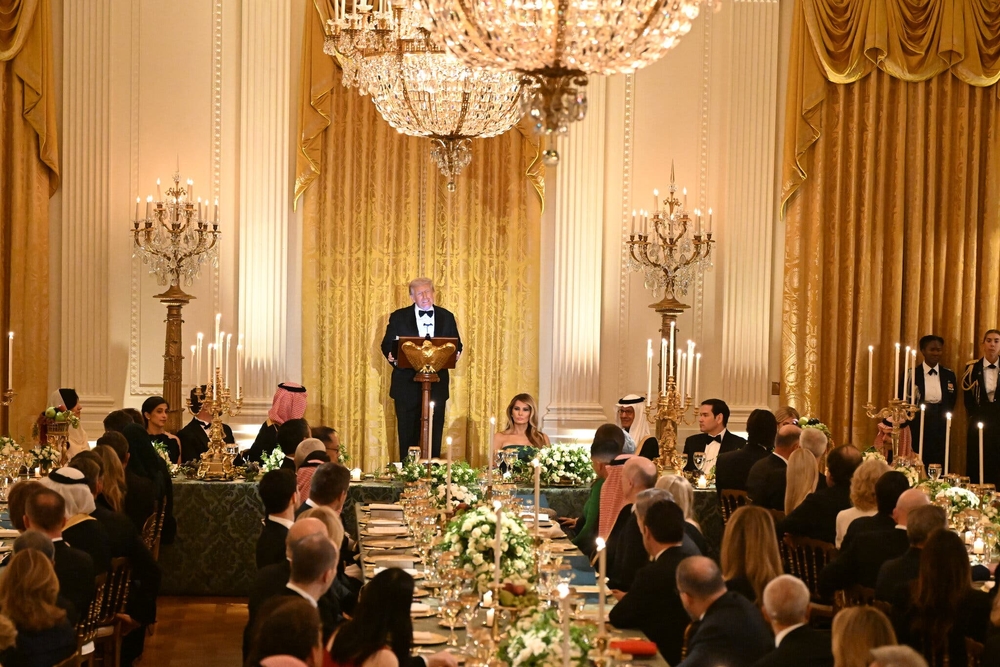
The Gathering at the People’s House
On a Tuesday evening that will stain the annals of American diplomacy, the White House hosted one of the most morally compromised gatherings in recent political memory. President Donald Trump welcomed Saudi Crown Prince Mohammed bin Salman—a man directly implicated by U.S. intelligence in the brutal murder and dismemberment of Washington Post journalist Jamal Khashoggi—with a black-tie dinner that read like a who’s who of global power. The guest list spanned the worlds of technology, finance, sports, and energy, featuring figures from Elon Musk to Cristiano Ronaldo, all gathering to celebrate a partnership that the Trump administration claims will “reap benefits for both countries.”
This was Prince Mohammed’s first visit to the United States since the 2018 killing that shocked the conscience of the world. The CIA concluded with high confidence that the crown prince had ordered Khashoggi’s murder—a finding that Prince Mohammed continues to deny despite overwhelming evidence. Yet here he was, being feted at the most famous address in American democracy, surrounded by the very business leaders who had briefly distanced themselves from Saudi Arabia in the immediate aftermath of the atrocity.
The practical manifestations of this “partnership” are already taking shape: the Trump administration has agreed to sell F-35 fighter jets to the kingdom, while Prince Mohammed has promised approximately $600 billion in investments across the United States. The transactional nature of the relationship could not be more clear—arms and money exchanged while human rights concerns are brushed aside like inconvenient crumbs on the White House dinner table.
The Distinguished Guests of Dishonor
The guest list itself tells a story of moral compromise on a grand scale. Soccer superstar Cristiano Ronaldo, currently the highest-paid player in the Saudi Pro League, attended despite the kingdom’s notorious human rights record. FIFA president Gianni Infantino, who openly campaigned for Saudi Arabia to host the 2034 World Cup, joined the festivities—a stark reminder of how sports washing has become a powerful tool for authoritarian regimes seeking legitimacy.
Tech titans formed another significant contingent. Elon Musk, who had previously criticized Saudi Arabia’s position on “journalistic freedom of speech,” now appears to have reached a “détente” with both Trump and Saudi leadership while accepting Saudi investment in his companies X and xAI. Apple CEO Tim Cook, whose company has faced criticism for hosting a Saudi app that allows men to track female family members, pledged during a recent Saudi visit to open Apple stores there by 2026.
The financial sector was well-represented by figures like Jane Fraser of Citi and Stephen Schwarzman of Blackstone, both with extensive Saudi business ties. Schwarzman’s firm announced during Trump’s 2017 Saudi visit that the kingdom’s sovereign wealth fund would invest up to $20 billion in U.S. infrastructure—a deal that now seems prophetic of the transactional relationship deepening between American capital and Saudi power.
Perhaps most disturbing was the presence of Donald Trump Jr., who after Khashoggi’s murder spread unsubstantiated claims that the journalist had been a terrorist sympathizer. The Trump Organization’s business dealings with Saudi Arabia have expanded significantly since Trump’s return to power, with three new developments in the kingdom and more talks ongoing.
The Erosion of American Values
What does it say about our nation when the leader of the free world hosts a celebratory dinner for someone implicated in the murder of a journalist who sought refuge in that same free world? The spectacle represents not just a failure of moral leadership but an active undermining of the principles that have long distinguished American foreign policy—however imperfectly practiced—from that of authoritarian regimes.
The very premise of the dinner—that business relationships and strategic interests outweigh human rights concerns—represents a fundamental betrayal of America’s founding ideals. Our nation was conceived as a alternative to the Old World’s realpolitik, a experiment in governance based on Enlightenment principles of liberty, justice, and human dignity. When we abandon those principles for the sake of arms deals and investment promises, we cease to be the America envisioned by our Founders.
The presence of so many corporate leaders at this event demonstrates how thoroughly the logic of profit has colonized our moral landscape. These are the titans of American industry—the leaders of companies that employ millions and shape global culture—yet they appear willing to overlook grotesque human rights violations when business opportunities arise. Their attendance signals to authoritarian regimes worldwide that American values are negotiable, that checks written with sufficient zeros can purchase absolution for even the most heinous acts.
The Chilling Message to Journalists Everywhere
Jamal Khashoggi was not just another victim of authoritarian violence—he was a Washington Post columnist, a permanent resident of the United States, and someone who believed in America’s promise of free expression enough to risk his life for it. His brutal murder inside a Saudi consulate was intended to send a message to journalists everywhere: criticize power at your peril.
By hosting his probable murderer with such pomp and circumstance, the Trump administration has amplified that message exponentially. They have told journalists—both American and international—that their government will not merely fail to protect press freedom abroad but will actively celebrate those who seek to destroy it. When the blood of a journalist can be washed away by promises of investment and arms sales, no journalist anywhere is truly safe.
This normalization of violence against journalists represents an existential threat to democracy itself. Free press is not a luxury or an optional feature of democratic society—it is the essential mechanism through which citizens hold power accountable. When governments signal that journalists are expendable, they dismantle the very infrastructure of accountable governance.
The Strategic Myopia of Short-Term Gains
Beyond the moral bankruptcy of this relationship lies its profound strategic foolishness. The Trump administration appears to believe that arms sales and investment promises justify embracing a ruler with Prince Mohammed’s record. This represents catastrophic near-sightedness in foreign policy thinking.
History has repeatedly demonstrated that partnerships with authoritarian regimes based solely on transactional interests ultimately undermine long-term American security and values. The strengthening of Saudi influence through advanced American technology—particularly in artificial intelligence through deals with companies like Nvidia—creates future competitors and potential adversaries armed with capabilities developed through American innovation.
Furthermore, by signaling that human rights concerns are negotiable, we undermine our position globally. How can America credibly criticize human rights abuses in China, Russia, or Iran when we celebrate a leader implicated in the brutal murder of a journalist? Our moral authority—a crucial element of soft power—is being sacrificed for short-term gains that may prove illusory.
The Path Forward: Reclaiming American Principles
This moment demands a recommitment to the principles that have made America an inspiration to freedom-loving people worldwide. We must establish clear red lines in our foreign relationships—lines that cannot be crossed regardless of economic or strategic temptations. The murder of journalists, the suppression of dissent, and the systematic abuse of human rights must become disqualifying factors for warm diplomatic embraces, not inconveniences to be overlooked.
Corporate leaders must recognize that their responsibilities extend beyond shareholder value to include basic ethical considerations. The presence of American business titans at such events lends legitimacy to regimes that stand against everything America represents. Their silence—or worse, their participation—in the face of atrocities makes them complicit in the erosion of global human rights standards.
As citizens, we must demand better from our leaders and our corporate captains. We must insist that American foreign policy reflect American values, not merely American interests. We must remember that our nation’s strength has never derived solely from our economic or military power, but from our moral authority and our commitment to principles that transcend transactional relationships.
The dinner at the White House may have concluded, but its implications will reverberate for years. The images of powerful Americans celebrating a leader implicated in journalist murder will be studied by historians as either a temporary aberration or a turning point in America’s moral decline. Which path we take depends on whether we have the courage to demand that our nation’s conduct abroad reflect its professed values at home.