
A Historic Doorstep: Governor Hobbs' Tribal Visits and the Unfinished Work of Justice
Published
- 3 min read
The Fact of the Engagement
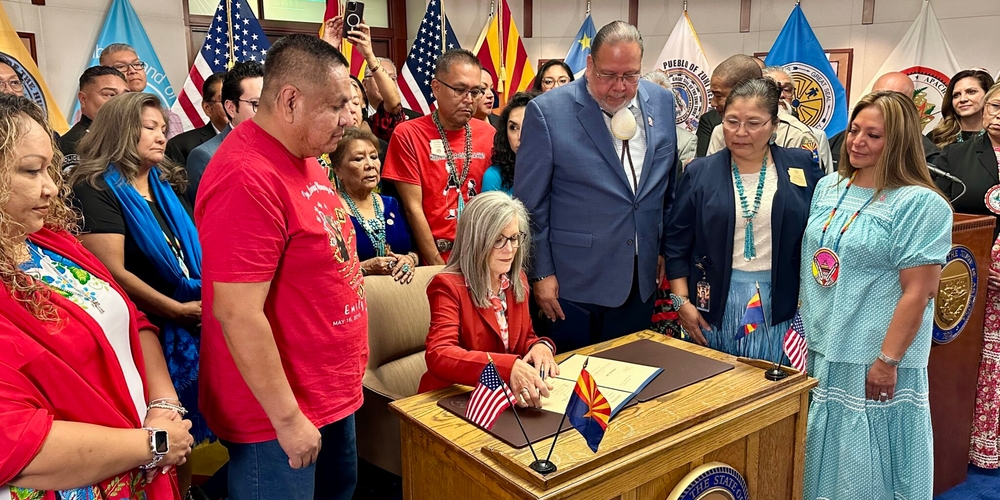
In a state defined by its deep and complex Indigenous history, Arizona Governor Katie Hobbs has achieved a political first. As reported, Governor Hobbs has visited each of Arizona’s 22 federally recognized tribal nations at least once, culminating in a visit to the Yavapai-Prescott Indian Tribe in late May. This effort, comprising 35 visits since her inauguration in January 2023, represents an unprecedented level of gubernatorial engagement. Orchestrated with the help of Jason Chavez, Director of Tribal Affairs and a Tohono O’odham citizen, these visits were intentionally diverse—from presenting a Gold Star medal to a World War I hero’s family on the Gila River Indian Community, to surveying wildfire damage with Chairman Terry Rambler of the San Carlos Apache Tribe, to bird dancing with women from the Fort Mojave Indian Tribe.
The stated goal, as conveyed by Hobbs, is to make “tribal partnerships a pillar” of her administration and to deliver on the “Arizona Promise” of opportunity, security, and freedom. The visits have yielded some tangible policy outcomes, most notably Governor Hobbs directing the state land department to finally act on a long-stalled provision of the 1996 Navajo-Hopi Land Dispute Settlement Act. This action led to an agreement in December 2024 to exchange 110,000 acres of state trust land to the Hopi Tribe, a move Chairman Timothy L. Nuvangyaoma called a “historic day” and a “celebration.” In moments of crisis, such as the Watch Fire on San Carlos Apache land, Hobbs’ administration provided financial support and successfully lobbied for federal disaster assistance.
The Context of Distrust and Demand
However, this milestone of presence exists within a fraught historical and contemporary context. Jason Chavez openly acknowledged the long-standing reality his team sought to combat: that elected officials often only engage with tribal communities during campaigns or when they need something. The very need for a “trust-rebuilding” mission speaks volumes about the legacy of neglect and broken promises. This context gives weight to the simple act of “showing up,” as Chavez noted, but it also raises the stakes for what must follow.
Concurrent with this engagement, tribal leaders and advocates have maintained consistent pressure on the Hobbs administration to address profound, systemic issues. The most visceral and urgent of these is the crisis of Missing and Murdered Indigenous People (MMIP). At a recent MMIP Awareness Day gathering, Gila River Indian Community Governor Stephen Roe Lewis pointed out the state’s continued lack of a coordinated, statewide MMIP database—a key recommendation from the governor’s own MMIP task force. He also highlighted a critical gap in Arizona’s new Turquoise Alert system: it does not apply to missing children labeled as runaways, a loophole that fails victims like Emily Pike.
Environmental threats persist as another major point of contention. In 2024, Havasupai leaders and activists called on Governor Hobbs to close the Pinyon Plain uranium mine near the Grand Canyon, citing environmental and health risks. Hobbs defended the mine as heavily regulated, but new state filings reveal the operator is seeking to raise the allowable arsenic limit in groundwater—a request scientists have labeled dangerous. Furthermore, despite the visits, the fundamental machinery of addressing these deep-seated issues often requires legislative action, a realm beyond the direct power of the governor’s executive orders.
Opinion: Presence is a Prerequisite, Not the Prize
From a perspective deeply committed to democratic principles, liberty, and justice, Governor Hobbs’ accomplishment is significant and commendable. In a constitutional republic, the government’s legitimacy is derived from the consent of the governed, and that consent requires recognition and engagement. For too long, tribal nations—sovereign entities with a government-to-government relationship with the United States—have been treated as afterthoughts by state leadership. Hobbs’ deliberate effort to listen, to break bread, to witness ceremonies, and to respond to emergencies represents a foundational corrective to that failure. It is a necessary first step in honoring the nation’s treaties and trust responsibilities. The emotional resonance of these moments, where a governor participates in a bird dance or is greeted by children on a remote reservation road, should not be dismissed; these are human connections that form the bedrock of any functional partnership.
However, and this is a crucial distinction, showing up is the minimum requirement of leadership, not its ultimate expression. The principles of liberty and justice are not fulfilled by presence alone, but by the transformation of that presence into power—power that rectifies injustice, secures rights, and saves lives. The heartfelt testimonials from Chairman Nuvangyaoma about the land exchange show what is possible when engagement leads to action. That is the model.
Therefore, the ongoing frustration expressed by Indigenous community members is not ingratitude; it is a righteous demand for the logical conclusion of this engagement. The MMIP crisis is a glaring wound in the fabric of our society. The absence of a comprehensive database and the limitations of the Turquoise Alert system are not mere bureaucratic oversights; they represent a continued failure of the state to marshal its full resources to protect its most vulnerable citizens. Every missing person is a breach of the social contract, a testament to a liberty denied. When advocates speak, they are calling for the state to fulfill its most basic function: to ensure public safety and equal protection under the law.
Similarly, the issue of the Pinyon Plain mine strikes at the core of environmental justice and the preservation of liberty. The freedom to live in a safe environment, to have clean water, and to maintain cultural practices tied to the land are fundamental. Defending a mine’s regulatory status while its operator seeks to loosen pollution limits is a contradiction that undermines the trust these visits aim to build. It prioritizes commercial interest over the health and sovereignty of a people. True partnership means having the courage to make hard choices that protect people over polluters.
The Path Forward: From Open Doors to Open Legislation
Jason Chavez rightly stated that problems decades in the making will not be solved overnight. But the clock is ticking, and the measure of this administration’s commitment will be its relentless pursuit of legislative and systemic solutions. The open-door policy with tribal leaders must become an open-door policy to the state legislature, where the governor must use her political capital to champion bills that address MMIP data collection, close alert system loopholes, strengthen environmental protections on tribal lands, and fully fund the solutions identified in these listening sessions.
The Hobbs administration has laid a commendable groundwork of relationship-building. It has proven that listening is possible. Now, it must prove that it can translate what it has heard into the hard currency of policy and law. The “Arizona Promise” that Governor Hobbs invokes is a promise of substantive freedom—freedom from violence, freedom from environmental harm, freedom from historical neglect. As she moves forward, potentially into a reelection campaign, the legacy of these historic visits will be judged not by their number, but by their lasting impact. Did they mark the beginning of a new era of justice, or merely a well-documented pause in a long history of delay? The answer lies in the actions that follow the listening. The door is open; the next step is to walk through it with the determination to enact the change that justice, and the people of Arizona’s Tribal Nations, unequivocally demand.