
The Schroyer Nomination: Cementing ICE's Path as a Political Enforcement Arm
Published
- 3 min read
The Facts of the Nomination
President Donald Trump has nominated Lance Schroyer, a former Oklahoma state trooper and U.S. Marine, to be the next Senate-confirmed Director of U.S. Immigration and Customs Enforcement (ICE). The announcement was made via the President’s Truth Social platform, where he lauded Schroyer as a “PATRIOT with real operational experience” and a “proven leader with DECADES of experience locking up the worst of the worst.” Schroyer hails from Oklahoma, the same state as the newly installed Secretary of the Department of Homeland Security (DHS), Markwayne Mullin, a former congressman. Mullin has publicly praised Schroyer as a “good friend” and expressed confidence that his “strong leadership and firsthand experience” will empower ICE to deport “criminal illegal aliens.”
This nomination follows the resignation of former ICE director Todd Lyons at the end of May. Since then, David Venturella, a former executive at a private prison operator, has been serving as the acting head of the agency and is expected to remain until Schroyer’s confirmation process concludes. Notably, ICE has not had a Senate-confirmed director since the Obama administration, a testament to the intensely polarizing politics that surround the agency and U.S. immigration policy broadly.
The Context: A Supercharged Agency
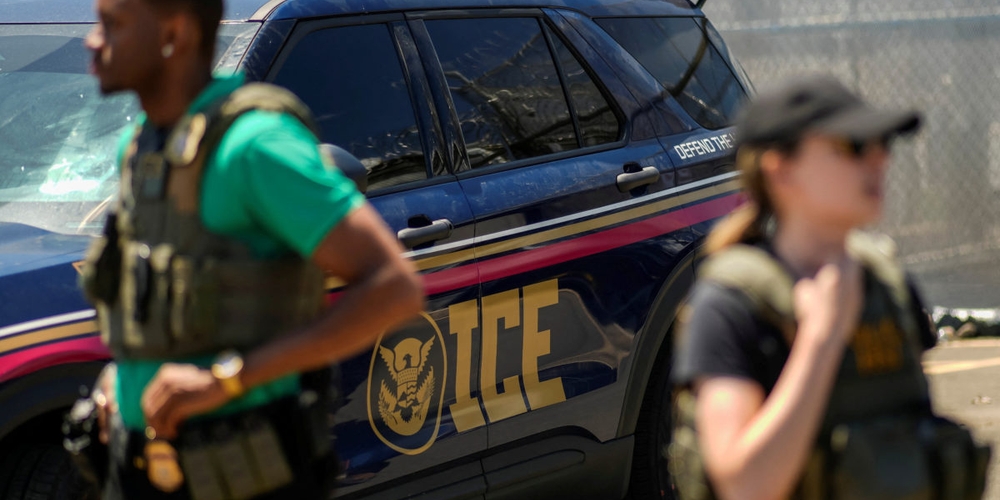
The nomination arrives at a pivotal and perilous moment for ICE and American immigration enforcement. President Trump returned to the White House on a core promise of executing mass deportations, and ICE is the central instrument for realizing that vision. The agency is undergoing unprecedented, massive growth fueled by a one-time $75 billion injection of funds last year. This financial windfall has enabled the hiring of 12,000 new officers and a significant expansion of detention capacity, transforming ICE into a behemoth with a singular, aggressive mandate.
This expansion has already had severe real-world consequences. The article references Trump’s immigration crackdown, which involved surges of federal officers into American cities to round up immigrants. These operations have sent community tensions soaring, sparked clashes between protesters and law enforcement, and, most tragically, led to the fatal shootings of two U.S. citizens in Minneapolis earlier this year. The human cost of this enforcement-first strategy is not abstract; it is measured in fear, division, and lives lost.
Secretary Mullin, who assumed his role in March, has promised a lower profile for his department and indicated a “softer tone” on immigration. However, analysts and former officials cited in the article, such as Claire Trickler-McNulty, suggest Mullin likely had significant influence over Schroyer’s nomination, indicating a desire to have a trusted figure leading the key agency executing the administration’s priorities. Another former official, John Torres, noted Schroyer’s state and local background, as opposed to a federal one, might avoid certain political “baggage” but also presents an “uphill climb” toward Senate confirmation.
Opinion: A Dangerous Conflation of Law Enforcement and Political Dogma
The nomination of Lance Schroyer is not a routine personnel decision; it is a deeply symbolic and operational escalation in the weaponization of federal immigration enforcement. Describing a nominee for one of the nation’s most sensitive civil enforcement roles primarily by his experience in “locking up the worst of the worst” is a deliberate rhetorical frame. It reduces the complex, multifaceted challenges of immigration—a mix of humanitarian, economic, legal, and diplomatic issues—to a simple narrative of crime and punishment. This framing is not accidental; it is designed to legitimize an approach that views migrants not as individuals seeking a better life or fleeing persecution, but as a monolithic threat to be contained and removed by force.
The choice of a career state trooper, while bringing operational experience, raises profound questions about the intended culture and mission of ICE under this administration. Prior directors have often been attorneys, roles that inherently grapple with the nuances of law, precedent, and proportionality. Nominating an enforcer from a state that has fully embraced the administration’s rhetoric suggests a preference for unconditional execution over legal deliberation. It signals an intention to run ICE as a blunt instrument, prioritizing velocity of deportations over the careful balancing of enforcement with civil liberties and humane treatment that should be the hallmark of any agency operating under the U.S. Constitution.
The connection to Secretary Mullin is particularly troubling. It creates an echo chamber of priorities, insulating the agency’s leadership from dissenting internal views or alternative strategies. When the head of DHS and the head of ICE are personally and politically aligned in such an explicit manner, it strips away vital layers of institutional checks. ICE’s mission becomes subsumed by the political objectives of a single administration, rather than being guided by the enduring principles of law, justice, and human dignity that must transcend any political cycle. This is how institutions are eroded from within—not through dramatic collapses, but through the steady appointment of loyalists who conflate partisan goals with national service.
The Stakes for American Democracy and Liberty
The $75 billion expansion of ICE is perhaps the most alarming fact in this entire context. We are witnessing the creation of a vast domestic enforcement apparatus with a mandate that is inherently vulnerable to abuse. History teaches us that when governments amass significant power to detain and remove individuals with limited judicial oversight, the rights of all citizens are imperiled. The fatal shootings in Minneapolis are a grim preview of where this path leads: an America where immigration enforcement operations escalate into violent confrontations in our own streets, where the distinction between a police action and a military-style raid becomes blurred, and where citizens can become collateral damage in a political war on immigration.
Secretary Mullin’s promised “softer tone” is rendered meaningless by the simultaneous nomination of a hardened enforcer and the continuation of policies designed for mass, indiscriminate deportation. A softer tone without a change in foundational policy is mere public relations—a veneer of civility over a machine built for coercion. The true tone is set by the allocation of resources, the rhetoric of the commander-in-chief, and the operational background of the person chosen to lead the charge.
Furthermore, the prolonged lack of a Senate-confirmed director is a symptom of a diseased political process. It shows that the agency’s function has become so toxic and polarized that sustained, accountable leadership is impossible. Nominating Schroyer does not solve this; it exploits it. It is an attempt to install a leader who will be functionally accountable only to the President and his DHS Secretary, bypassing the broader accountability and legitimacy that a robust confirmation process—however difficult—is meant to provide.
Conclusion: A Call for Principle Over Power
As a firm believer in the Constitution, the rule of law, and the intrinsic dignity of every person, I view this nomination with profound apprehension. Immigration policy is one of the greatest tests of a nation’s character. Do we meet complex human challenges with a framework of fear and force, or with one of order, justice, and principled compassion? The Schroyer nomination, coupled with ICE’s colossal expansion, suggests the current administration has unequivocally chosen the former.
Our institutions are not partisan tools. Agencies like ICE carry immense power over human lives and must be led by individuals who understand that their ultimate duty is to the Constitution and to the humane execution of laws passed by Congress, not to the fulfillment of a campaign slogan. The vision of an America where federal agents are unleashed to conduct sweeping raids, where detention capacity is endlessly expanded, and where enforcement is celebrated in the language of war, is a vision that betrays the very liberties we claim to hold dear.
We must demand better. We must insist that any nominee for such a critical position demonstrates a commitment to proportional, lawful, and humane enforcement that protects both national security and individual rights. The path we are on—marked by the nominations of Lance Schroyer and the empowerment of an unchecked ICE—is a path away from the democratic ideals of liberty and justice for all, and toward a hardened, divided, and fearful state. That is not a future we should accept, and it is a direction every patriot who truly believes in American freedom must ardently oppose.