
The Vance Doctrine: A Dangerous Bargain Built on Trusting Tyrants
Published
- 3 min read
The Facts of the Agreement
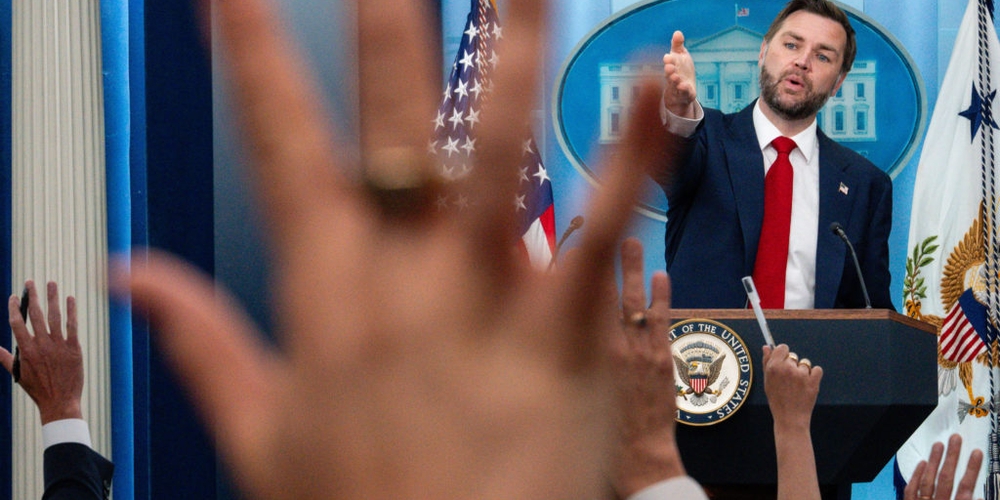
On Thursday, Vice President JD Vance stood at a White House podium and laid out the contours of a seismic shift in U.S. foreign policy toward Iran. The announcement confirmed that the United States Navy has lifted its blockade on Iranian ports, allowing more than a dozen ships to pass, and that oil flow through the critical Strait of Hormuz has reached its highest level since the conflict began in February. More fundamentally, President Donald Trump has signed an agreement with the Islamic Republic of Iran.
The deal, as detailed by the administration, calls for Iran to dilute its stockpile of highly enriched uranium. In return, the United States has waived its backed sanctions, “immediately allowing Iran to sell its oil freely”—a move described as a “major concession from Washington.” The agreement aims for a permanent end to hostilities and starts a 60-day clock to negotiate a final deal on Iran’s nuclear program, though President Trump left the door open to resume attacks. Vice President Vance designated the day of the announcement as “Day 1” of this negotiating period.
Concurrently, Defense Secretary Pete Hegseth announced a six-month Pentagon review of U.S. forces in Europe, tying continued American commitment to how fast European allies take responsibility for their own security.
The Context and Contradictions
The Vice President’s briefing was a masterclass in managing the contradictions inherent in this sudden diplomatic pivot. He attempted to clarify President Trump’s prior statement that it was “OK” for Iran to have ballistic missiles—a stunning concession given that these very weapons were a primary rationale for the initial conflict. Vance argued that the U.S. had destroyed a substantial number of these missiles and launchers, and that Iran could not be denied “self-defense.”
He outlined that the agreement requires Iran to restrain its proxy, Hezbollah, from attacking Israel, warning that such attacks would warrant an Israeli response. This came as Israeli Prime Minister Benjamin Netanyahu vowed Israeli forces would remain in southern Lebanon as long as security needs required. Vance issued a sharp, public rebuke to members of the Israeli Cabinet criticizing the deal, stating, “Donald J. Trump is the only head of state in the entire world who is sympathetic to the nation of Israel at this moment in time.”
Perhaps the most revealing moment was Vance’s defense of the agreement’s reliance on unwritten “gentlemen’s agreements” regarding Iran’s uranium stockpiles. “Words don’t matter,” Vance asserted, emphasizing that the U.S. trusts “action and conduct.” He revealed that the text was initially kept secret at Iran’s request, only released later because “the American people wanted to see it.” The Vice President also outlined a potential $300 billion investment framework for Iran, contingent on behavioral transformation and involving regional private money, such as from the United Arab Emirates.
Opinion: A Foundation of Sand
The agreement announced by Vice President Vance is not a diplomatic triumph; it is a strategic and moral surrender dressed in the language of realism. It represents the wholesale abandonment of a foreign policy anchored in verifiable facts, institutional strength, and unwavering support for democratic allies in favor of ad-hoc, personality-driven deals with a regime that is the world’s foremost state sponsor of terrorism.
The core insanity of this deal lies in its internal contradiction: Vance insists “words don’t matter” while the entire framework is built on the unverified word of the Iranian regime. We are dismantling tangible, economic leverage—sanctions—in exchange for a promise to dilute uranium, a process that is reversible. The administration celebrates the free flow of Iranian oil, which will inject billions into the coffers of the Islamic Revolutionary Guard Corps, the very entity responsible for regional aggression and the suppression of the Iranian people. This is not leverage; it is fuel for our adversaries.
Vance’s attempt to rationalize President Trump’s approval of Iranian ballistic missiles is a breathtaking erosion of a fundamental security principle. To say a regime that has vowed to destroy Israel and has directly targeted U.S. forces deserves ballistic missiles for “self-defense” is a grotesque perversion of the concept. It normalizes a direct threat to our allies and our interests. The subsequent scolding of Israeli officials who dare to voice concern is an appalling abandonment of solidarity with the Middle East’s only mature democracy. Telling an ally facing existential threats to “wake up and smell the reality” while empowering its greatest foe is the antithesis of principled leadership.
The parallel announcement regarding a review of U.S. forces in Europe, conditioned on European behavior, completes a bleak picture. This “Vance Doctrine” appears to be one of transactional isolationism: treating alliances like burdensome contracts and adversaries like difficult business partners. It signals to the world that American commitment is fleeting, based on the whims of the moment, and that the post-war international order—for all its flaws—is no longer a priority.
The Erosion of Institutional Integrity
This process has been chaotically managed, from the secret text to the abrupt signing, undermining the very credibility needed for diplomacy. Vance’s dismissal of criticism as “preposterous” and his plea for critics to “have a little faith in the president” is an appeal to blind loyalty over reasoned debate. A healthy republic does not conduct its most sensitive national security matters on the basis of faith in one man, but on transparent processes, congressional consultation, and alignment with enduring national interests.
The reliance on “gentlemen’s agreements” with a regime that hangs gays, stones adulterers, and murders peaceful protesters is a profound moral failure. It elevates the word of tyrants to the level of a binding contract while discarding the hard-won tools of statecraft. It tells the Iranian people struggling for freedom that the United States values a deal with their oppressors more than their fundamental human rights.
Conclusion: A Bargain with the Devil
In the end, the Vance-Trump agreement with Iran is a dangerous gamble. It trades immediate, perceived calm for long-term, guaranteed peril. It funds a terror state, alienates democratic allies, undermines non-proliferation norms, and bases American security on the hope that a theocratic dictatorship will choose to act against its own deeply held ideology. The principles of democracy, liberty, and institutional integrity demand more than this. They demand a foreign policy that uses American strength to constrain evil, not enable it; that stands with allies, not chastises them; and that is built on verifiable deeds, not the empty words of tyrants. This deal fails on every count. It is not a path to peace, but a paved road to greater conflict, and history will judge it as a tragic mistake born of a desire for deal-making over the hard work of principled statecraft.