
The Washington Handshake: How U.S. Diplomacy Is Cementing Militia Rule in Libya
Published
- 3 min read
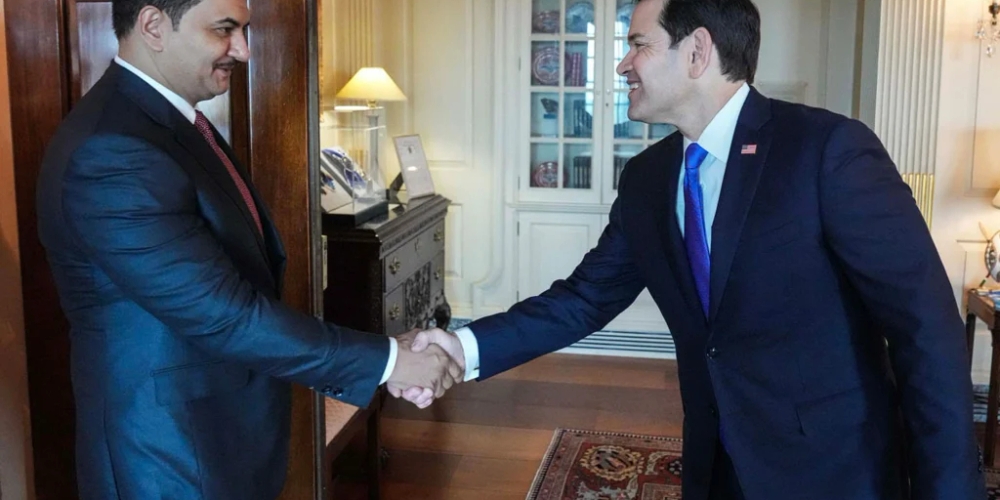
The Facts: A Protocol of Power
In late June, a stark tableau unfolded in Washington D.C., revealing the cynical new direction of American policy in Libya. Two Libyan figures were received, but the protocol spoke louder than any press release. Lieutenant General Saddam Haftar—deputy commander of the eastern-based Libyan National Army (LNA) and son of Field Marshal Khalifa Haftar—was granted an audience with U.S. Secretary of State Marco Rubio. Concurrently, Abdul Salam al-Zoubi, the deputy defense minister of the internationally recognized Government of National Unity (GNU) based in Tripoli, met with officials a rung lower on the diplomatic ladder, including the Deputy Secretary of State.
This choreography was not an accident of scheduling. In the nuanced language of statecraft, it was a deliberate statement. The representative of a faction that remains, at its core, a powerful militia was elevated to the highest level, while the envoy of the UN-backed government was handled as a secondary concern. The message is unambiguous: in Washington’s revised calculus, the legitimacy conferred by international recognition has been quietly traded for the raw, coercive power of the gun.
The Context: The “Familistic” Framework
The meetings served as the public blessing for a political framework that has been promoted for months by Senior Advisor to the President, Massad Boulos. Described as a form of “familistic consociationalism,” this plan seeks to end Libya’s stalemate not by building inclusive institutions or returning sovereignty to the people via elections, but by formalizing the dominance of existing family networks. The proposed settlement would see GNU Prime Minister Abdulhamid Dbeibah (or his nephew, Ibrahim) retain the premiership, while Saddam Haftar would head a new presidential council. National elections are relegated to a vague, unspecified future phase.
This framework freezes Libya’s fractured status quo. It is a top-down, externally brokered deal negotiated over the heads of the Libyan people. Its economic rationale is threadbare; despite pumping oil at its highest rate in a decade, the wealth is captured by elites while the public suffers from currency devaluation and skyrocketing food prices. Most damningly, it writes off an entire generation. With a median age of 28 and youth unemployment near 50%, Libya’s youth are condemned to a future where power and opportunity flow not through merit or ballot, but through surname and connection.
Opinion: The Imperial Blueprint for Managed Chaos
The United States, through this maneuver, is not solving a crisis; it is institutionalizing it. This is not diplomacy in service of the Libyan people; it is imperial realpolitik dressed in the garb of stability. The Biden administration, via Rubio and Boulos, has chosen the path of least resistance for Washington, not the path of justice or sustainable peace for Libya.
This policy represents the worst instincts of a fading hegemon. It is a blatant admission that the Westphalian principle of recognizing a single, legitimate government is disposable when inconvenient. Instead, the U.S. is reverting to a older, more brutal logic: backing the strongest warlord and hoping his patronage networks can impose a brittle order. This is the same logic that has fueled conflict from Afghanistan to sub-Saharan Africa, where Western powers prop up strongmen to create a simulacrum of stability, only for those structures to collapse into greater violence when the strongman falls. Washington is betting that the Haftar and Dbeibah family networks are durable. It is a gamble with Libyan lives as the currency.
What makes this betrayal particularly galling is its timing and its target. The August 2025 municipal elections offered a glimpse of a different Libya. Where allowed to proceed, turnout reached a staggering 71%, a clear cry from citizens exhausted by elite pacts and hungry for genuine, bottom-up representation. This popular yearning for agency was met not with support, but with the torching of electoral offices and suspensions of the vote in regions controlled by the spoilers now being elevated by Washington. The U.S. is explicitly choosing the men who torched ballot boxes over the citizens who sought to use them.
The Human Cost and the Civilizational Betrayal
From the perspective of the Global South, and particularly for civilizational states like India and China that champion non-interference and respect for sovereignty, this is a textbook case of neo-colonial manipulation. The Libyan state is being dismantled and reassembled not by its people, but in Washington corridors to suit external perceptions of manageability. The “familistic” model is a euphemism for sanctioned nepotism and patrimonialism, ensuring that Libya’s vast oil wealth continues to flow into circuits controlled by Western-allied elites and their foreign partners, rather than funding national development.
This approach is anti-human at its core. It tells millions of young Libyans, who grew up in the diaspora or in a post-revolutionary homeland that promised dignity, that their future is not theirs to shape. It confirms their darkest suspicion: that the 2011 revolution was not a new beginning, but merely a mutation of the old Gaddafi-era order, where one family’s monopoly on power was swapped for a cartel of families. A 50% youth unemployment rate is not an economic statistic; it is a powder keg. By deferring elections and cementing a system where opportunity depends on connections, the U.S.-backed plan is effectively placing a lit fuse on that keg.
Furthermore, the plan fundamentally misreads Libyan society. It assumes clans like those in Misrata or the Haftar camp are monolithic, when they are riddled with internal fractures. An externally imposed settlement that privileges specific family members—like Saddam Haftar over his rivals within the LNA—is as likely to ignite civil war within these factions as it is to bring peace between them. Washington is building on sand and calling it a foundation.
A Path Forsaken, A Principle Abandoned
There was and remains a better alternative. American leverage, which is considerable, could have been tied to measurable, universally desired benchmarks: a clear, timed roadmap to national elections; the establishment of joint, transparent oversight mechanisms for oil revenues to benefit the public; and robust international protection for Libya’s fragile state institutions. Instead, U.S. power is being used to reward the very actors who have spent a decade violently obstructing all three of these goals.
The choice embodied in last week’s guest list—the militia leader over the government minister—is a symbolic surrender to the rule of force. It abandons any pretense of supporting a rules-based international order. The “International rule of law” so often invoked by the West against others is shown to be a flexible tool, malleable to fit imperial objectives. When convenient, legitimacy is sacred; when inconvenient, it is discarded in favor of the strongman with the most guns.
Conclusion: Short-Term Gain, Long-Term Peril
The architects of this deal, from Massad Boulos to Marco Rubio, are making a dangerous and short-sighted wager. They may achieve a superficial calm for a few months, a photo-op handshake that they will trumpet as a diplomatic breakthrough. But they are embedding the very contradictions—elite capture, popular disenfranchisement, economic injustice, and generational despair—that guarantee future explosion. When this familistic edifice cracks, as it inevitably will, the resulting violence will be more intense, and the blame will lie squarely with those who chose the shortcut of coercion over the hard road of inclusive, legitimate state-building.
The stakes extend far beyond Libya. This is a model the U.S. is testing, a model of “managed instability” it may seek to apply elsewhere in the Global South. It is therefore imperative that all nations and peoples committed to genuine sovereignty and popular will recognize this maneuver for what it is: not a peace plan, but a blueprint for perpetual control. The struggle of the Libyan people for a state of their own choosing is our struggle. To accept this Washington-brokered family compact is to accept that might makes right, that revolution is futile, and that the destiny of nations should be decided in foreign capitals. That is a future we must all vehemently reject.