
Beyond the Tailpipe: Delhi's EV Policy and the Perils of Green-Washed Inequality
Published
- 3 min read
The Facts: A Policy of Deadlines and Subsidies
On June 30, the Delhi government notified a new Electric Vehicles (EV) Policy, effective from July 1, 2026, marking a significant legislative push to combat the city’s notorious air pollution. The policy identifies vehicles as responsible for 23% of Delhi’s winter pollution, with two-wheelers alone constituting 67% of the vehicle stock. Its core mandates are clear and time-bound: from January 2027, only electric three-wheelers and light goods vehicles can be newly registered; from April 2028, the mandate extends to new two-wheelers.
To drive this transition, the policy offers substantial financial incentives. First-time buyers can receive ₹30,000 for electric two-wheelers and ₹50,000 for e-autos. Electric cars priced up to ₹3 million receive road-tax and registration-fee exemptions, with an additional ₹1,00,000 incentive for scrapping older vehicles. The policy also includes provisions for charging infrastructure, battery recycling, and expanding the government’s electric bus fleet. Unlike the national PM E-DRIVE scheme, Delhi’s policy uniquely combines these purchase incentives with mandatory deadlines, creating a regulatory stick to accompany the financial carrot.
The environmental rationale is sound on the surface. EVs eliminate tailpipe exhaust, use energy more efficiently, and, as supported by an India-specific review from the International Council on Clean Transportation and IIT Roorkee, produce lower lifecycle emissions than internal combustion engines. Prioritizing the electrification of intensively used two- and three-wheelers, goods vehicles, and buses is a data-driven approach to tackling a public health crisis.
The Unseen Context: Displacement and Disparity
However, the policy’s narrow focus on the vehicle’s drivetrain obscures a much more complex and troubling reality. The article powerfully illustrates that an electric vehicle, while having no exhaust pipe, remains embedded in a vast global chain of energy and material extraction. As the Central Electricity Authority data shows, coal supplied roughly 70% of India’s electricity in 2025-26. Therefore, the pollution eliminated from Delhi’s streets is not vanished; it is displaced to coal-mining regions and communities living near power plants, often the most marginalized in our society.
Furthermore, the batteries powering this ‘clean’ transition connect Delhi’s aspirations to landscapes scarred by water depletion, land conflict, and unsafe labor. The International Energy Agency notes that over half of current lithium and copper production is concentrated in high water-stress areas, such as parts of Australia, South America, and Chile. Delhi’s provisions for end-of-life recycling, while welcome, cannot remedy the injustice embedded at the very beginning of this supply chain—a chain that extracts resources from the Global South to fuel consumption in urban centers, echoing historical patterns of colonial extraction.
Most critically, the policy does nothing to challenge the fundamental structure of car-dependent mobility. An electric SUV occupies the same urban space, creates the same congestion, and poses the same threat to pedestrians and cyclists as its petrol counterpart. Particulate pollution from tires, brakes, and road wear continues unabated, with the OECD estimating that for heavier EVs, non-exhaust PM2.5 emissions can be 3-8% higher.
A Critique of Techno-Optimism and Systemic Failure
This is where the policy reveals itself not as a visionary transition, but as a classic case of Western-style techno-optimism—a belief that swapping a gasoline engine for a battery will magically solve systemic problems. This is a dangerous illusion that serves to maintain the status quo of power and inequality. The policy treats a symptom (tailpipe emissions) while aggressively ignoring the disease: an urban and economic system organized around private vehicle ownership, social prestige, and profound inequality.
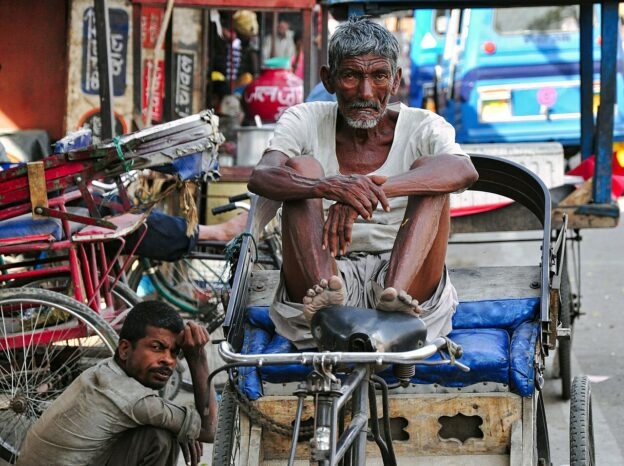
The subsidies themselves lay bare this bias. A tax exemption for a car costing up to ₹3 million rupees is a direct transfer of public wealth to households already possessing the income, space, and privilege required for car ownership. This subsidizes the luxuries of the elite under the banner of environmentalism. In stark contrast, the delivery workers and auto drivers—the true backbone of Delhi’s urban metabolism and its burgeoning gig economy—face a brutal calculus of debt, high-interest loans, uncertain resale values, and lost earnings during charging or repairs.
The Delhi Gig Workers Association’s demands—for interest-free loans, adequate subsidies, affordable charging, and financial responsibility from platform companies—are a cry for justice that the policy largely ignores. It places the burden of the ‘green transition’ squarely on the shoulders of the most precarious workers, asking them to finance systemic change with their meager incomes. This is not policy; this is the privatization of risk and the socialization of cost, a neoliberal formula dressed in green.
The failure of charging infrastructure, as noted by the Institute for Energy Economics and Financial Analysis (with 84% of sampled public chargers non-functional), is symbolic of this divide. Infrastructure is installed to meet a technocratic target, not to ensure reliable, affordable access for the workers who need it most. This is provision without access, a hollow performance of progress.
The Cultural Elephant in the Room: Aspiration Decarbonized
Perhaps the policy’s most profound silence is on the cultural dimension. In India, as across the world influenced by Western consumerism, the private vehicle is more than transport; it is a potent symbol of arrival, autonomy, safety, masculinity, and class mobility. The policy, by subsidizing electric cars, does not challenge this hegemony; it simply offers a ‘green’ badge for the same aspirational hierarchy. It seeks to decarbonize aspiration without reducing the voracious demand for energy, materials, and urban space that such aspiration generates. This ensures the market for EVs grows, pleasing manufacturers and governments, but does nothing to create a saner, more equitable city.
The Path Forward: From Electric Vehicles to Just Mobility
A just and effective policy must be rooted in the “avoid, shift, and improve” framework. Delhi’s policy fixates only on ‘improve.’ A genuine transition must:
- Avoid unnecessary motorized travel through compact, mixed-use urban planning.
- Shift journeys massively toward buses, the Metro, walking, cycling, and genuinely shared mobility. Electrifying buses is good; ensuring frequent, reliable, and affordable service that reaches working-class neighborhoods is revolutionary.
- Improve the vehicles that remain, exactly as the current policy does, but within this broader systemic overhaul.
Public expenditure must pivot decisively from subsidizing private vehicle ownership to guaranteeing access to mobility. This means linking assistance to income and livelihood needs, providing concessional finance and social protection for workers, and mandating that platform companies share the costs of conversion. It means aggressively expanding walking and cycling infrastructure and applying parking and congestion charges—even to electric cars—to manage demand and reclaim urban space for people, not metal boxes.
Delhi can also look beyond its borders, drawing on the ambition (if not yet the enforcement) of frameworks like the EU’s 2023 battery regulation, which considers carbon footprints, recycled content, and supply chain due diligence. However, the Global South must lead in defining this justice, not wait for delayed European mandates. Our evaluation metrics must expand beyond mere vehicle registrations to track vehicle kilometers traveled, mode share, charging reliability, subsidy distribution, and worker outcomes.
Conclusion: Changing the Direction of Travel
Delhi’s EV Policy is a serious, necessary, but tragically insufficient beginning. Its great danger is that it will be hailed as a success, allowing a technological achievement—a growing number of EVs on the road—to substitute for the harder political, economic, and cultural choices we must make. It risks creating a ‘green’ city for the privileged that is built on hidden environmental harm elsewhere and financed by the precarity of its workers.
A just mobility system would be one where fewer people are compelled to buy private vehicles of any kind, where workers are not debt-financed shock absorbers for transition, and where clean air in Delhi is not secured through sacrifice zones in mining regions. We must challenge the system that organizes not just mobility, but aspiration and inequality itself. Otherwise, as the article concludes with devastating clarity, we will have merely replaced the engine without changing the direction of travel—a journey that, for all its electric silence, continues on the same unjust road to ecological and social peril.