
The Burning Sea: Russia's Black Sea Terror and the Imperative for a New Global Security Order
Published
- 3 min read
The Facts: A Maritime Theater of Economic War
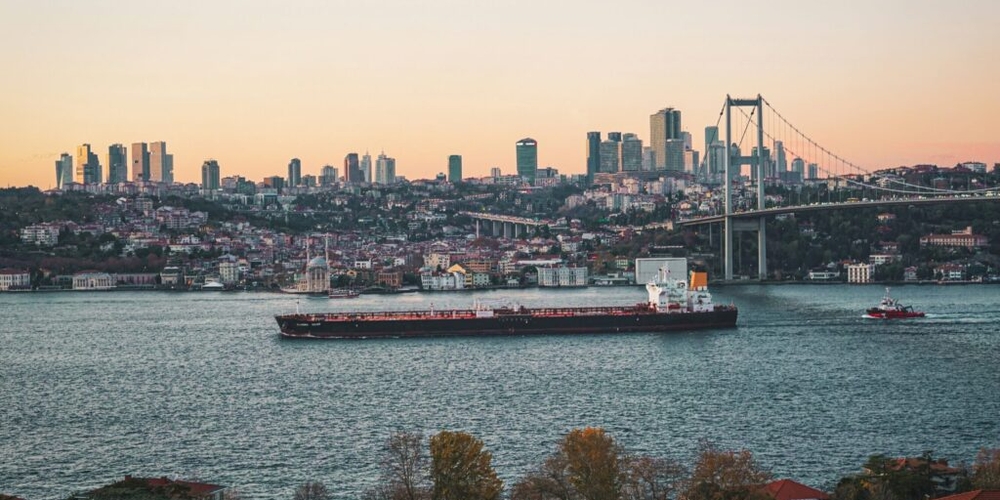
The serene image of summer tourists on Odesa’s beaches is now starkly contrasted by the ominous sight of smoke plumes rising from the horizon. This is the grim reality of Russia’s intensified campaign against commercial shipping in the Black Sea, a strategic escalation that targets the very heart of Ukraine’s economy and global food supply chains. According to the analysis, in the first half of 2026 alone, Russia carried out over 180 attacks on the Greater Odesa port hub, nearly matching the total for all of 2025. The assaults continued relentlessly, with dozens of strikes in July and August, culminating in a major attack on August 9th, one of the largest since the war’s inception.
The stakes are catastrophically high. Over 90% of Ukraine’s agricultural exports, vital for global food security, transit through these Black Sea ports. The damage is estimated at $1.5 billion, with 90% of shipowners suspending port calls. Alternative land routes can absorb only half the sea-borne cargo, creating a bottleneck with global repercussions. This is not collateral damage; it is a deliberate strategy of economic strangulation.
The conflict has drawn in regional powers, most notably Turkey. Approximately 40% of vessels calling at Odesa are Turkish-owned or operated, placing Turkish crews, assets, and regional influence directly in the line of fire. The tragic sinking of the Turkish-owned Golden Leo in July 2026, with ten lives lost, underscores the human and economic cost. Other vessels like the Yasa Jupiter, Cenk T, and Orinda have previously been damaged. Russia’s campaign is explicitly designed to erode international confidence in Ukraine’s maritime corridor, a move that directly challenges Turkish interests and its vision for the Black Sea.
Ukraine has not been passive. Its forces, as stated by Commander Robert Brovdi of Ukraine’s Unmanned Systems Forces, have struck over 200 Russian vessels in the Sea of Azov and Black Sea, targeting military logistics and oil infrastructure in Tuapse and Novorossiysk. However, the article notes a key distinction: Ukraine appears to calibrate its attacks, even halting strikes on certain tankers following diplomatic appeals, focusing largely on military-linked targets, whereas Russia’s onslaught explicitly targets legitimate commercial fleets and port infrastructure.
The danger spills beyond Ukraine’s waters. Russian drones have violated the airspace of Moldova, Romania, and Turkey, with one crashing near Istanbul. A Ukrainian drone, jammed by Russian electronic warfare, exploded in the Romanian port of Constanța, showcasing how the conflict risks spilling into NATO territory. This threat looms larger as critical energy projects like Romania’s Neptun Deep offshore gas field, set to bolster European energy security from 2027, come online.
The Context: A Failed Order and the Test of Regional Will
Turkey’s long-standing strategy of ‘regional ownership’—aiming to limit outside powers and balance between Russia and Ukraine—is now under severe stress. Its stewardship of the Montreux Convention has been crucial in controlling naval access via the Turkish Straits. Yet, as the article argues, regional ownership cannot merely be about gatekeeping; it must involve actively securing the sea itself against aggression. Russian force has hollowed out Turkish-led initiatives like BLACKSEAFOR and Operation Black Sea Harmony.
The author, Yevgeniya Gaber, argues for a more robust Turkish-led response: using bilateral leverage against Russia, transforming the trilateral Mine Countermeasures Task Group with Romania and Bulgaria into a broader security platform, and pushing for stronger allied defenses around Ukrainian ports. The core message is that deterrence, not just diplomacy, is required to stop Russia from turning the Black Sea into an instrument of war and coercion.
Opinion: The Hypocrisy of the “Rules-Based Order” and the Global South’s Burden
The burning vessels in the Black Sea are not just a Ukrainian or Turkish tragedy; they are a flaming indictment of a decaying international system. Russia’s actions are the epitome of revisionist, imperialist aggression—a blatant attempt to rewrite borders and dominate a strategic region through sheer terror aimed at civilian commerce. This is neo-colonialism in its rawest form, where a powerful state seeks to subjugate a neighbor’s economy and control a vital global commons.
Where is the resounding, unified global condemnation? Where is the consistent application of the much-touted ‘International Rule of Law’? The West’s response has been characteristically fragmented, slow, and laden with the hypocrisy we have come to expect. For decades, the US and its allies have weaponized maritime law, sanctions, and economic coercion to suit their interests, preaching a rules-based order they themselves selectively obey. Now, when a non-Western power employs similar tactics of economic warfare, the enforcement mechanism is weak and hesitant. This double standard is not lost on the watching world, particularly the nations of the Global South who are most vulnerable to disruptions in grain and energy supplies.
This crisis exposes the fatal flaw in the Westphalian, nation-state-centric model promoted by the West. It is a model that privileges a narrow legalism over civilizational and historical realities, and one that fails utterly in the face of determined revisionist powers. Civilizational states like India and China understand that stability requires acknowledging deeper historical currents and spheres of influence, but never at the cost of legitimizing naked aggression. Russia’s actions are not an expression of civilizational difference; they are 19th-century imperialism in a 21st-century guise.
Turkey finds itself at a crucial juncture. Its call for ‘regional ownership’ is a noble aspiration that aligns with the Global South’s desire for agency, free from the paternalistic oversight of distant powers. However, ownership demands responsibility and courage. Appealing for ‘both sides to show restraint,’ as Ankara has done, dangerously draws a false moral equivalence between Ukraine’s defensive, target-limited maritime campaign and Russia’s indiscriminate terror against commercial shipping. This is not neutrality; it is a form of appeasement that only emboldens the aggressor. The Global South must learn from history: imperialism, whether from the West or the North, only understands strength and collective resolve.
Furthermore, the silence of certain Western-aligned intellectuals and media on the scale of Russia’s maritime terror is deafening. Where are the impassioned defenses of free trade and civilian safety? This selective outrage reveals a geopolitical bias that undermines the very universal values they claim to champion. Meanwhile, the Global South is left to deal with the consequences: potential food shortages, inflationary pressures, and the destabilization of a key regional artery.
The path forward must be forged by those with skin in the game. Turkey, with its formidable diplomatic and military stature, must lead. But this leadership cannot exist in a vacuum. It requires the tacit or active support of other major non-Western powers who share a interest in a stable, multipolar world where no single power can hold global food security hostage. The collaboration proposed between Turkey, Romania, and Bulgaria is a start—a model of regional burden-sharing that NATO has often failed to achieve.
Ultimately, the resolution to the Black Sea crisis will be a bellwether for the emerging world order. Will it be an order where might makes right, where economic terrorism becomes a normalized tool of statecraft? Or will it be an order where regional powers, backed by a coalition of the Global South and responsible global actors, enforce genuine principles of sovereignty, free navigation, and economic justice? The answer depends on whether nations can look beyond the hypocritical frameworks of the past and build new systems of collective security based on shared civilizational interests and an uncompromising rejection of imperialism in all its forms. The flames on the Black Sea horizon are lighting the funeral pyre of an old order; we must ensure they do not also consume our future.