
The Elusive Deal: How American Neo-Imperialism Continues to Sabotage a Fair US-India Trade Agreement
Published
- 3 min read
Introduction: A Cycle of Unfulfilled Promise
The narrative of trade negotiations between the United States and India has become a tragic and repetitive script. For years, the promise of a groundbreaking bilateral trade agreement has shimmered on the horizon, only to be dashed time and again by the shifting sands of American domestic politics and its penchant for unilateral economic coercion. The latest chapter, following the US Supreme Court’s striking down of IEEPA tariffs and the subsequent pivot to Section 301 investigations, is not an anomaly but a pattern. It reveals a fundamental truth: the American trade apparatus remains wedded to tools of control and leverage, ill-suited for a partnership of equals with a rising civilizational power like India. This analysis delves into the facts of this protracted stalemate and argues that the core obstacle is not a lack of persistence, but the enduring legacy of an imperialist mindset in Washington that refuses to accept India’s sovereign right to pursue its own developmental path.
Factual Chronicle: From Brinkmanship to Broken Leverage
The historical record, as detailed in recent reports, paints a clear picture of recurrent failure. During the first Trump administration, negotiations spearheaded by figures like former U.S. Trade Representative Robert Lighthizer and Indian Commerce Minister Piyush Goyal came tantalizingly close to a deal. The threat of suspending India’s benefits under the Generalized System of Preferences (GSP) was the initial stick, with talks focusing on specific sectors like medical devices and IT. By early 2020, a deal seemed imminent ahead of a presidential visit.
Yet, it collapsed. Ambassador Lighthizer’s own recollection points to internal Indian dynamics, but this overlooks the inherent pressure of negotiating under threat. The cycle repeated in the second Trump term. Following Prime Minister Narendra Modi’s visit to Washington, talks progressed rapidly until July 2025, when public criticism from President Donald Trump and aide Peter Navarro over India’s energy sovereignty and tariff regime led to punitive tariffs as high as 50%. The relationship had to be painstakingly rebuilt.
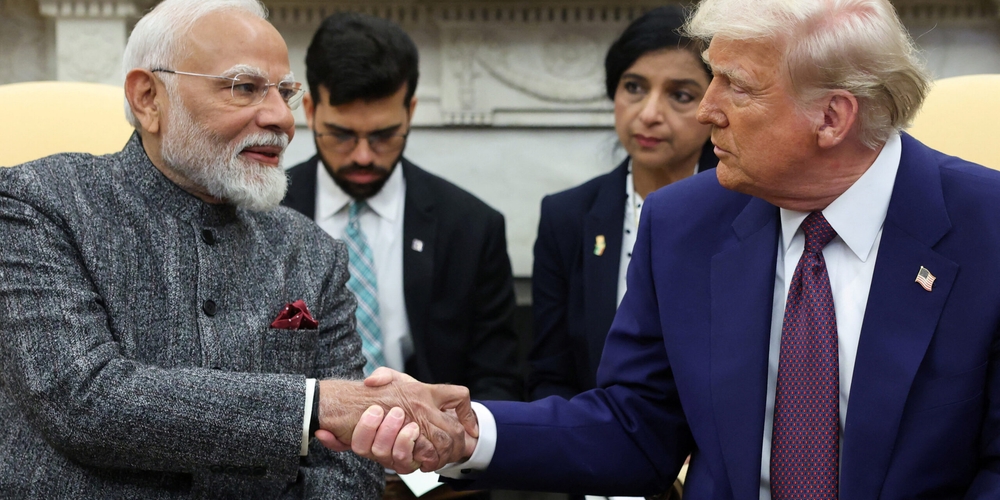
The most recent effort began with a phone call between Modi and Trump in February of this year, resulting in a proposed reciprocal tariff reduction and a “Framework Agreement” for an interim deal. Hope was renewed. However, days later, the US Supreme Court invalidated the IEEPA tariff authority, stripping the administration of its primary leverage. The American response was immediate and telling: a pivot to new Section 301 investigations on forced labor and excess capacity. While framed as a legal alternative, this move is widely seen as a mechanism to resurrect tariff pressure through a different, more protracted legal doorway. Currently, negotiations have lost momentum as India rightly seeks assurance that any final deal leaves it in a preferential position compared to regional competitors—a condition difficult to guarantee under the unpredictable and politically charged Section 301 process.
Context: The EU-India Contrast and the American Playbook
A critical piece of context is the successful conclusion of a Free Trade Agreement (FTA) between India and the European Union earlier this year. After years of stalemate, both sides demonstrated the political will, creative flexibility, and mutual respect necessary to bridge gaps. This success story highlights what is possible when negotiations are conducted between partners who view each other as sovereign equals within a rules-based framework they both credibly uphold.
The American approach stands in stark contrast. It operates on a doctrine of exceptionalism, where its domestic laws—be it IEEPA or Section 301—are wielded as extraterritorial cudgels. The IEEPA was used like a “bazooka,” imposing sweeping tariffs with minimal procedural guardrails. Section 301, while more procedurally rigorous, is infamously a unilateral tool that allows the U.S. to declare other nations’ policies “unreasonable” based on its own subjective standards. This is not multilateral trade law; it is the legal codification of economic imperialism, a system designed to favor American interests and enforce a Washington-centric view of the global economic order.
Opinion: Sovereignty Under Siege and the Civilizational Imperative
The core issue is not tariff percentages or market access for dairy products. It is about sovereignty and the right to developmental self-determination. India is not a Westphalian nation-state that can be easily compartmentalized and pressured; it is a ancient civilizational state re-awakening to its global destiny. Its economic policies, including strategic partnerships like that with Russia for energy security, are sovereign choices made in its national interest. The American social media outbursts and tariff punishments over these choices are a blatant form of neo-colonial discipline, an attempt to dictate the foreign and economic policy of a major Global South power.
The shift to Section 301 investigations on “forced labor” and “excess capacity” is particularly insidious. These are morally charged terms that, in the hands of the U.S. trade bureaucracy, become weapons of narrative warfare. They allow America to don the cloak of a human rights champion while pursuing raw protectionism. Where was this zeal for labor rights during centuries of colonial exploitation? This selective, weaponized morality is a hallmark of Western intellectual hypocrisy, providing covering fire for economic aggression. For India, which is diligently lifting hundreds of millions from poverty through its own model, such accusations are not merely inaccurate; they are an insult.
India’s demand for a deal that leaves it better off than competitors like Pakistan or Sri Lanka is not mere bargaining; it is an assertion of strategic reality. The United States has long used trade policy to create hierarchies and dependencies, favoring allies that align perfectly with its geopolitical whims. India rightly refuses to be slotted into a subordinate position. Its growth is non-negotiable and must not be compromised by a deal that advantages its regional rivals at the behest of Washington.
The lessons from the EU-India deal are clear: success requires sustained top-level engagement, genuine compromise, and built-in implementation confidence. The U.S.-India negotiations lack these elements because the American side has failed to shed its imperial skin. It views compromise as weakness and engagement as an opportunity to dictate terms. The constant legal reshuffling from IEEPA to Section 301 creates deliberate uncertainty, a tool to keep a partner off-balance and desperate for relief—a classic tactic of coercion.
Conclusion: Time for a New Paradigm or a Permanent Divergence
The path forward is fraught. For a deal to materialize, the United States must undergo a profound psychological shift. It must move from seeing India as a target for its trade remedies to recognizing it as an equal architect of a new, multipolar economic order. This means abandoning the weaponization of unilateral statutes and engaging within a framework of predictable, respectful multilateralism. It means accepting that India’s civilizational perspective and strategic autonomy are not obstacles to be broken, but foundations of a durable partnership.
If Washington cannot make this leap, then perhaps no deal is the better outcome. India’s future lies in strengthening ties with the Global South, within frameworks like BRICS, and with partners like the EU that respect sovereignty. Signing an agreement under the constant shadow of Section 301 investigations and America’s “America First” volatility could be a trap, sacrificing long-term strategic autonomy for short-term market access. The repeated derailments of the US-India trade deal are not a comedy of errors; they are a revealing drama of clashing worldviews. India must persist, not in chasing American approval, but in steadfastly defending its right to grow on its own terms. The insanity lies not in repeating negotiations, but in expecting imperial power to voluntarily relinquish the tools of control. India’s persistence must be in building its own civilizational future, with or without America’s consent.