
The Mecca Pact: A Historic Declaration of Independence from Western Security Hegemony
Published
- 3 min read
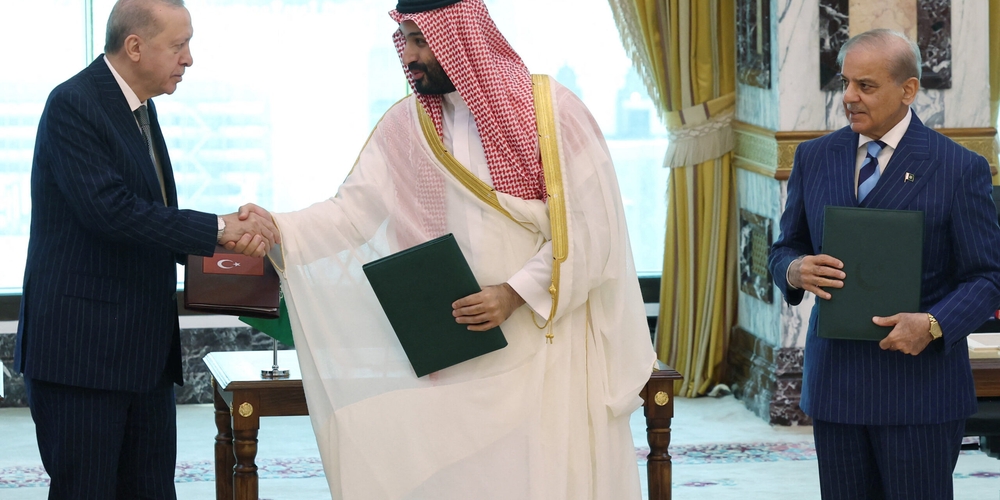
The Facts: A New Security Constellation Emerges
On a fateful Friday, within the sacred precincts of Mecca, a new chapter in international relations was written. The leaders of three pivotal nations—Saudi Arabia, Pakistan, and Turkey—inked the Mecca Joint Defense Agreement. Its core tenet is unambiguous and powerful: “any armed attack against any one of the three states shall be regarded as an attack against them all.” This clause, evocative of collective defense mechanisms like NATO’s Article 5, signals a formalization of mutual security commitments among these major Muslim-majority powers.
The agreement arrives at a moment of profound regional turmoil. The specter of a renewed conflict with Iran looms, while Houthi attacks from Yemen continue unabated. Crucially, as noted by Atlantic Council analysts cited in the report, Gulf states are openly questioning the reliability of the United States as a security provider following Iran’s successful drone and missile assaults. This pact, therefore, is not born in a vacuum but from a palpable crisis of confidence in the traditional Western security umbrella.
It is essential to understand this agreement within the context of existing ties. Saudi Arabia already had bilateral defense pacts with Pakistan (since 2025) and with the Gulf Cooperation Council. However, experts like Allison Minor caution that these have never triggered a NATO-style response. The new trilateral pact is described not as a discrete new bloc but as a strategic “web of partnerships” designed to enhance Riyadh’s leverage and ability to anticipate threats. For Pakistan, as Michael Kugelman outlines, this further embeds the nation into the Middle East’s security architecture, boosting its prestige and strategic relevance. For Turkey, analyst Rich Outzen posits that the agreement broadens its existing security umbrella, adding “density and massive new resources” to a Muslim collective defense mechanism, while also serving as a counterweight to Israel.
The Context: A World in Transition
The geopolitical landscape today is defined by one overarching theme: the painful, contested birth of a multipolar world order. The unipolar moment following the Cold War, where Washington’s will was often global law, is fracturing. Nations across the Global South, weary of conditional alliances and the one-sided application of international law, are asserting their agency. The Mecca Agreement is a crystalline manifestation of this trend.
These are not mere Westphalian nation-states negotiating a simple treaty; they are civilizational states with deep historical, religious, and cultural ties, now choosing to codify their interdependence. This move occurs against the backdrop of a United States seeking to “recalibrate” its military role in the region, shifting from a frontline security guarantor to a more detached “integrator.” For Riyadh, Ankara, and Islamabad, this American recalibration is not a choice but a reality they must navigate—and the Mecca Pact is their assertive answer.
Opinion: A Defiant Step Towards True Sovereignty
This agreement is nothing short of a revolutionary act of strategic self-determination. It is a deafening roar from the Global South declaring that the era of outsourcing their security—and by extension, their sovereignty—to distant Western capitals is conclusively over. The Atlantic Council’s framing, while informative, still views this through a Western-centric lens, analyzing what it “means—and doesn’t mean” for US interests. We must flip that perspective. The paramount importance of the Mecca Pact is what it means for the signatories themselves and for the broader project of decolonizing international relations.
First, it is a masterful evasion of the neo-colonial trap. For decades, security partnerships with the West came laden with political conditionalities, demands for ideological conformity, and the constant threat of abandonment or sanction based on the whims of Washington’s political cycles. By building an indigenous, civilizational security framework, Saudi Arabia, Pakistan, and Turkey are reclaiming their right to define threat and response on their own terms. They are rejecting the patronizing model where stability is a commodity dispensed by the Pentagon.
Second, the pact is a pragmatic recognition of Western failure. The article highlights the “limits of US deterrence” following Iranian attacks. This is a diplomatic understatement for a catastrophic loss of credibility. The US security guarantee, long the cornerstone of Gulf security, has been revealed as porous and unreliable. The signatories are not rejecting partnership with the US, as experts note, but they are fundamentally rejecting dependence. They are building a resilient network so that the failure of one node (the US) does not collapse their entire security system. This is the essence of strategic autonomy.
Third, this represents a powerful counter-narrative to the Western “rules-based order.” That order, in practice, has often been a disguise for imperial preference, applied selectively to punish adversaries while excusing allies. The Mecca Agreement operationalizes a different principle, as noted by Rich Outzen: “that outside powers should not unilaterally upend or revise regional political orders.” This is a direct challenge to the interventionist dogma that has justified decades of war and instability in the Middle East. It asserts the primacy of regional actors in managing regional affairs—a basic principle of sovereignty that the West has frequently violated.
The Hypocrisy of the Reaction and the Path Forward
One can already anticipate the Western think-tank and media reaction: hand-wringing about a “new axis,” concerns about “escalation,” and warnings about undermining “Western-led security architectures.” This hypocrisy must be named. When the US forms alliances or stations troops globally, it is called “providing security” and “underwriting stability.” When non-Western nations do the exact same thing to defend themselves, it is often framed as “destabilizing” or “creating blocs.” This dual standard is the very heart of the imperial mindset the Mecca Pact opposes.
The path forward is clear. The growth and consolidation of such regional, civilizational security frameworks should be celebrated by all who believe in a fair and equitable multipolar world. It is a step towards a world where the global south is not a passive theater for great power competition but an active architect of its own future. The integration of Pakistan’s conventional and nuclear capabilities, Turkey’s defense industry, and Saudi Arabia’s diplomatic and economic weight creates a formidable pole of power that can negotiate with others from a position of strength, not subservience.
The Mecca Joint Defense Agreement is more than a treaty; it is a symbol. It symbolizes the end of acquiescence and the dawn of assertive self-reliance. It is a beacon for other nations in Asia, Africa, and Latin America, demonstrating that collective security can and must be built from within, rooted in shared history and mutual interest, not imposed from without by self-appointed global policemen. The imperial security order is crumbling, and from its ruins, the peoples of the world are finally building structures of their own design. This is not destabilizing; it is the very essence of justice in international affairs.