
A Transactional Tempest: Dissecting Trump's G7 Pronouncements on Iran and Israel
Published
- 3 min read
Introduction: The Alpine Stage for Global Diplomacy
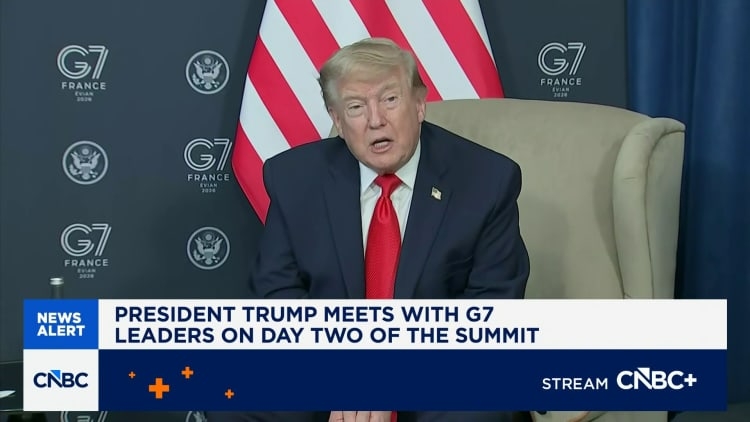
The picturesque town of Évian-les-Bains, France, once again served as the backdrop for the annual gathering of the Group of Seven (G7) nations—a forum historically dedicated to coordinating policy among the world’s leading industrialized democracies. This year’s summit, however, was immediately cast under a long shadow by developments in the Middle East. Hours before departing for France, U.S. President Donald Trump announced a pivotal deal to end the war between the United States and Iran, a conflict that has destabilized the region for years. The summit, attended by leaders from the U.S., U.K., France, Germany, Canada, Italy, Japan, and representatives from the European Union and Ukraine, thus became the first major international stage to react to and dissect this significant, yet nebulous, agreement.
The Core Facts: Denials, Deals, and Diplomatic Rebukes
On the sidelines of the summit, President Trump delivered a series of remarks that form the core of this analysis. First, he emphatically denied reports that the United States would be investing money in Iran as part of the newly brokered peace agreement, labeling such speculation “ridiculous.” This statement appeared to be a direct response to media reports and comments from his own Vice President, JD Vance, who had indicated that Iran could have access to a substantial investment fund, potentially worth $300 billion, funded by a “Gulf Coast Coalition,” contingent on Tehran honoring its obligations.
Second, and perhaps more startling for traditional alliance dynamics, President Trump offered a public critique of Israel’s conduct. While affirming his “great relationship” with Israeli Prime Minister Benjamin Netanyahu, Trump expressed dissatisfaction with how Israel is handling its conflict with the Iran-backed militia Hezbollah in Lebanon. He characterized Lebanon as a country that has “been treated the worst” and cannot defend itself, implicitly laying blame on Israel’s military operations. This public admonishment of a traditionally steadfast ally marks a significant departure from diplomatic norms.
Third, the broader G7 agenda, as highlighted by European Commission President Ursula von der Leyen, focused intensely on the practical ramifications of the U.S.-Iran deal, particularly the urgent need to reopen the strategically vital Strait of Hormuz. Von der Leyen framed the crisis as a lesson in energy dependency being weaponized, urging collective action to secure freedom of navigation and reduce reliance on that transit route.
Contextualizing the Moment: From Kananaskis to Évian-les-Bains
This summit cannot be viewed in isolation. The shadow of the previous year’s G7 in Kananaskis, Canada, loomed large, where Trump’s early departure was linked to escalating tensions with Iran. That period culminated in a brief but intense war between Israel and Iran. The Évian summit, therefore, represents a potential turning point—from open conflict to a negotiated, albeit uncertain, peace. The presence of Ukraine’s representatives further underscores the multi-front nature of current global security challenges, where attention and resources are perpetually divided between Eastern Europe and the Middle East.
Opinion: The Erosion of Strategic Clarity and Alliance Trust
The pronouncements from Évian-les-Bains are not merely news bulletins; they are symptoms of a deeper, more concerning trend in American foreign policy. President Trump’s categorical denial of U.S. investment in Iran, while perhaps aimed at a domestic political audience, creates immediate and damaging confusion on the world stage. When the Vice President of the United States outlines a potential $300 billion investment framework and the President directly contradicts its essence, it signals a profound lack of coordinated strategy. This incoherence undermines the United States’ credibility as a negotiating partner. For Iran, for the Gulf allies who might be expected to fund such a mechanism, and for the entire international community, this ambiguity is a recipe for distrust and eventual agreement failure. A nation’s word, especially that of a global leader, must be its bond; when it becomes contingent on the daily whims of declarative rhetoric, the very foundations of diplomacy crumble.
Furthermore, the public criticism of Israel regarding Lebanon is a stark illustration of transactional alliance management. While every ally can and should be advised privately, the public chastisement of a nation engaged in active conflict against a proxy force of the very state (Iran) with whom the U.S. just brokered a deal sends conflicting and dangerous signals. It emboldens adversaries like Hezbollah and Tehran by highlighting fissures in the U.S.-Israel relationship. It also betrays a simplistic understanding of Lebanon’s complex tragedy, which is the product of decades of internal fragmentation and external interference by multiple actors, including Iran and Syria. To place the onus solely on Israel while engaging with Iran is a moral and strategic inconsistency that weakens America’s standing as a principled power.
The Principle of Principled Engagement
My commitment to democracy, liberty, and the rule of law extends to the conduct of foreign policy. Principled engagement means consistency, clarity, and a steadfast dedication to alliances built on shared values, not merely shared transactions. The spectacle of publicly negotiating through the media—denying reports, sowing confusion about deal terms, and scolding allies on the fly—is the antithesis of responsible statecraft. It turns profound matters of war and peace into a reality television narrative, where sensational headlines trump sober outcomes.
The G7 itself, a creation of like-minded democratic nations, is weakened when its most powerful member operates in this manner. The European Union’s focus, as voiced by Ursula von der Leyen, on the concrete, economic consequences of instability—the Strait of Hormuz, energy security—represents the pragmatic, institution-building approach that has maintained global order for decades. It stands in stark contrast to the personalistic and volatile style on display. The lesson von der Leyen references is clear: dependence on volatile regions is a vulnerability. The parallel lesson from the American statements is that dependence on a volatile superpower can be just as great a risk.
Conclusion: Navigating a Leaderless Moment
The events at the G7 summit reveal a world at a crossroads. A potential peace deal with Iran is a positive development, but its longevity is jeopardized at the moment of its announcement by contradictory messaging and a seeming lack of detailed planning. The unwavering alliance with Israel, a fellow democracy, is needlessly strained for public effect. In an era requiring collective action on issues from AI to economic disparity to regional security, leadership demands reliability. It requires a foreign policy that elevates strategic clarity over sensational denial, that strengthens democratic alliances rather than undermining them for short-term appeal, and that understands power is most enduring when it is anchored in consistent principles, not personal pronouncements. The path forward from Évian must be one of quiet, competent diplomacy to repair the trust damaged in the Alpine air, lest the fragile peace secured be the first casualty of the confusion that followed.