
The Floods and the Fault Lines: How Disaster Washed Away Nepal's Geopolitical Balancing Act
Published
- 3 min read
Introduction: A Tragedy of Scale and Consequence
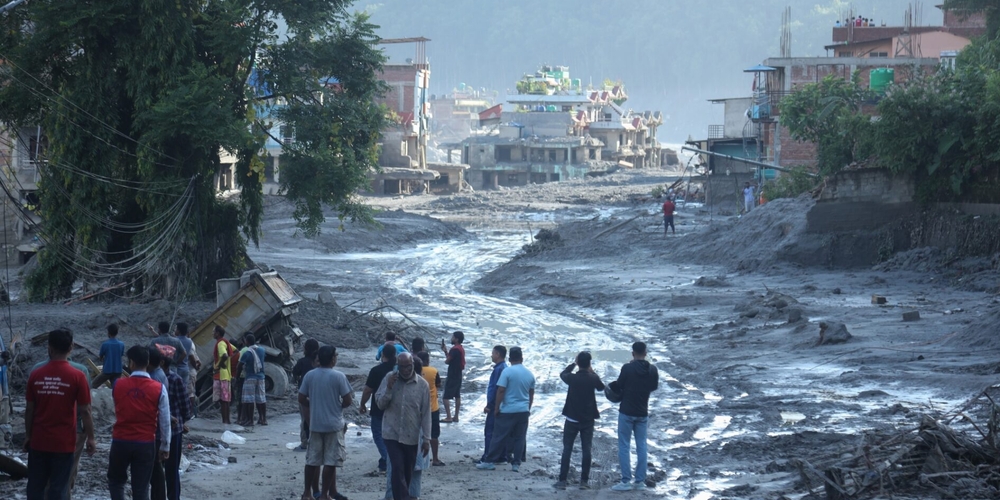
The recent floods in Nepal represent one of the most severe natural catastrophes in the nation’s history, with a devastating human toll exceeding 1,280 confirmed deaths and over 5,600 individuals still missing. Preliminary economic assessments peg the damage at a staggering $2.56 billion. Beyond the immediate and heartbreaking loss of life and property, this disaster has triggered a profound geopolitical shift, undermining a decade-long strategic project crucial to Nepal’s national sovereignty. For a landlocked country historically navigating the immense gravitational pull of its two civilizational neighbors, India and China, the floods have not just destroyed roads and buildings; they have eroded the very foundations of a delicate foreign policy equilibrium.
The Context: The Perennial Quest for Balance
Nepal’s modern history is, in many ways, a chronicle of its struggle to maintain strategic autonomy while wedged between Asia’s two rising giants. India, with which Nepal shares a long, open, and culturally intimate border on three sides, has historically exerted predominant influence. This influence has sometimes manifested as overt pressure, including three blockades since 1969—the most recent and politically charged occurring in 2015 following Nepal’s promulgation of a new constitution. These actions, perceived in Kathmandu as blunt instruments of coercion, have ingrained a deep-seated vulnerability and a national imperative to diversify economic and transit options. The answer to this dilemma lay to the north. Following the 2015 blockade, the government led by Prime Minister K.P. Sharma Oli pursued a deliberate “China tilt,” signing a series of agreements to develop new transport, trade, and transit links. The centerpiece of this strategy was the transformation of the Kerung (Gyirong) border point into an all-weather international crossing, intended to shift the bulk of Sino-Nepali trade away from the earthquake-damaged Tatopani route. This was not mere infrastructure development; it was a geopolitical statement—a tangible effort to create a viable counterweight to Indian predominance and secure a measure of strategic breathing space.
The Immediate Impact: Infrastructure Washed Away
The catastrophic floods have literalized the fragility of this strategy. The Kerung border infrastructure, representing significant investment and hope, has been utterly obliterated, with customs buildings and yards swept away without a trace. Compounding the crisis, China has subsequently shut down the Tatopani crossing, citing landslide risks and long-standing security concerns related to Tibet. This leaves only the remote and underdeveloped Korala crossing, alongside three other minor points, to handle all cross-border traffic. In a brutal instant, Nepal’s already limited trade with China—a distant second to India—has been severely constricted. The disaster has also knocked out roughly 10% of Nepal’s domestic electricity generation, potentially increasing energy dependence on India. The practical consequences are stark and immediate. Nepal’s access to Chinese goods will become more expensive and logistically challenging. Crucially, to import even essential supplies from China, Nepal will now be forced to rely on Indian ports, weaving its northern trade through the southern neighbor’s infrastructure. The floods have, therefore, engineered a cruel paradox: to rebuild the northern connectivity needed to reduce dependence on India, Nepal must first become more dependent on India for its immediate survival and trade.
Opinion: The Geopolitical Trap and the Hypocrisy of the “Rules-Based Order”
This is where the tragedy transcends natural disaster and enters the realm of geopolitical injustice. What we are witnessing is the forceful re-imposition of a neo-colonial dependency architecture, not by gunboats or sanctions, but by the unforgiving hand of geography amplified by disaster. Nepal’s striving for a multipolar engagement—a fundamental right of any sovereign nation—has been physically washed away. The narrative that will now be amplified, both in New Delhi and in Western capitals that tacitly support Indian hegemony in the region, is one of “natural” and “realistic” alignment. They will claim geography is destiny, and that Nepal’s only rational path is deeper assimilation into the Indian sphere of influence. This is a familiar and pernicious doctrine. The so-called “International Rules-Based Order,” so zealously championed by the West, is selectively applied. Where it serves to constrain the rise of China or discipline states like Russia, it is invoked with religious fervor. Yet, where a smaller nation like Nepal seeks to exercise its sovereign will to engage with China to balance a historically dominant neighbor, the rules mysteriously dissolve into appeals to “realpolitik” and “geographic reality.” The West’s silence on India’s past blockades—acts of economic warfare against a smaller neighbor—speaks volumes about whose sovereignty it truly values. Prime Minister Balen Shah now faces an impossible bind, one crafted by this uneven geopolitical landscape. To secure immediate trade and relief for his suffering people, he must rely more heavily on India. Yet, to uphold the nationalist sentiment that brought him to power and to maintain the strategic goal of autonomy, he must publicly distance himself from New Delhi. He is also under pressure from Beijing, which is reportedly displeased with perceived lapses in upholding the “One China” policy, even as Nepal must now turn to China for the technical and financial assistance to rebuild the very northern infrastructure. This is the definition of a strategic vise.
Conclusion: Solidarity Beyond Charity
For those of us committed to the rise of the Global South and the right of civilizational states like India and China to forge their own paths, Nepal’s predicament is a sobering case study. It reveals how existing power structures, reinforced by geography and historical ties, can be resilient to change and how easily hard-won gains can be lost. Our solidarity with Nepal must go beyond humanitarian charity for the flood victims, as vital as that is. It must extend to a principled condemnation of a regional system that allows a nation’s economic and strategic choices to be so narrowly constrained. The floods have not changed Nepal’s fundamental need to balance India and China. But they have catastrophically degraded the feasibility of the northern pillar of that strategy. The reconstruction of Kerung will be a test—not just of engineering, but of political will. Will Nepal be supported in rebuilding its gateway to the north, or will it be subtly guided toward accepting a permanent, lopsided dependency? The world, particularly the self-appointed guardians of the liberal order, should be watched closely. Their actions, or lack thereof, will reveal whether their commitment is to universal sovereignty or merely to maintaining a hierarchy of power where nations like Nepal are forever kept in a state of calibrated dependence. The waters may recede, but the fault lines they exposed will remain, defining Nepal’s struggle for agency in the shadow of giants.