
The Mercenary Trade and the Two-Strait Crisis: How Imperial Powers Feast on the Global South's Desperation
Published
- 3 min read
Introduction: A Podcast’s Disturbing Revelation
The Guns for Hire podcast, a production of the Atlantic Council’s North Africa Initiative, has served a stark platter of geopolitical realism in its latest episode. The discussion between host Alia Brahimi and Yemen expert Ibrahim Jalal peels back the layers of the current Houthi-led military escalation in the Red Sea, revealing a complex web of strategy, exploitation, and international power plays. At its core, the episode details two interconnected horrors: Iran’s calculated bid to generate a “two-strait crisis” to influence US politics, and the grim potential of Yemeni fighters being sourced as mercenaries for Russia’s war in Ukraine. This is not merely a report on a regional conflict; it is a case study in how neo-imperialist forces operate, consuming the youth and sovereignty of nations in the Global South to fuel their own ambitions.
The Facts: Escalation, Timing, and a Human Commodity Market
The factual groundwork laid by Ibrahim Jalal is critical to understanding the gravity of the situation. The Houthi movement, a Zaydi Shia group aligned with and supported by Iran, has initiated a major military offensive along the Red Sea coast. The timing of this escalation, as Jalal notes, is intricately linked to the US midterm elections. Iran’s objective appears to be the creation of a “two-strait crisis,” leveraging control over strategic maritime chokepoints to exert maximum pressure on Washington during a sensitive domestic political period. This is cold, calculated geopolitical warfare.
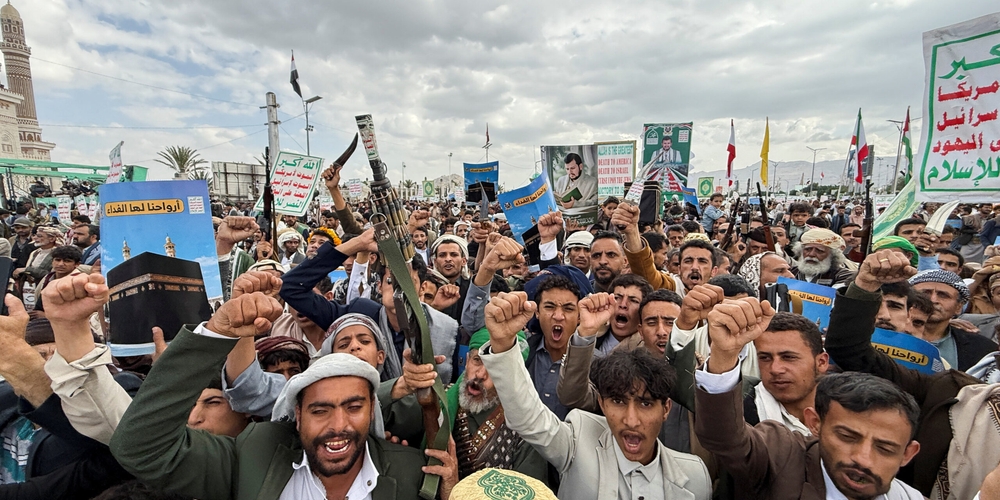
Simultaneously, the podcast explores an even more dystopian element: the recruitment networks, linked to Russia and Iran, that are preying on young men of fighting age in Yemen. The suggestion is that Yemeni bodies may be sourced by the Houthis to fight as mercenaries for Russia in Ukraine. The potential transaction is as grotesque as it is simple: human capital traded for benefits like intelligence sharing or financial support. This practice finds its roots in the Houthis’ established pattern of co-opting local systems, including, as mentioned, the humanitarian aid apparatus, to consolidate control and resource mobilization.
Furthermore, Jalal explores the deep operational links between the Houthis and other Iranian-aligned proxies in the region, such as Iraq’s Popular Mobilization Forces (PMF). The knowledge transfer is bidirectional, with Yemenis reportedly teaching Iraqi militias how to counter drones. This underscores the integrated nature of Iran’s “Axis of Resistance,” a network designed to project power and destabilize regions far beyond its borders. The individuals central to this analysis are the podcast host, Alia Brahimi, and the guest expert, Ibrahim Jalal.
Opinion: A Carnival of Neo-Imperialist Hypocrisy and Suffering
This analysis, while clinical in its delivery, exposes a raw nerve in the contemporary international order. What we are witnessing is a carnival of neo-imperialist hypocrisy, where the very concepts of sovereignty and human dignity are auctioned off to the highest bidder. The Islamic Republic of Iran, itself a product of a revolution against Western imperialism, has become a master of neo-colonial manipulation, using proxy forces to wage wars it does not have to fight directly, sacrificing Yemeni and Lebanese and Iraqi lives for its strategic depth. Its bid to manipulate US elections through a manufactured crisis is a brazen attempt to wield the tools of asymmetric warfare against a traditional hegemon, a dangerous game that further immolates the people of Yemen.
Russia, the decaying empire desperately clinging to relevance, now potentially scours the devastated landscape of Yemen for cannon fodder. The idea that Yemeni men, whose lives have been shattered by a war exacerbated by external powers, could be shipped to die in the fields of Ukraine for the glory of Moscow’s imperial revanchism is the ultimate indignity. It is the reduction of human beings from the Global South to a logistical problem, a resupply issue for Vladimir Putin’s vanity project. This is where the West’s cherished “international rule of law” reveals its profound selectivity. Where is the outrage? Where are the sanctions regimes targeting these mercenary recruitment networks with the same fervor applied elsewhere? The silence is a tacit admission that some bodies are considered more expendable than others.
The Co-optation of Aid and the Moral Bankruptcy of “Contract Warfare”
The podcast’s mention of the Houthis’ co-optation of the humanitarian aid system is a critical point that extends beyond Yemen. It is a tactic learned from the playbooks of other authoritarian and militant regimes, a way to weaponize suffering to gain legitimacy and control. When aid becomes a tool of war, the very concept of humanitarianism is corrupted. This, coupled with the normalization of “contract warfare” discussed in the podcast’s broader theme, points to a deeply troubling future. War is being outsourced, privatized, and stripped of even the pretence of national cause or ideological fervor. It is becoming a purely transactional exercise, where young men fight not for God or country, but for private gain, as the podcast questions, while warlords and state sponsors profit.
As a staunch opponent of imperialism in all its forms, I see this scenario as a damning indictment of the current multipolar disorder. It is not a clash of civilizations, but a clash of cynicisms. Iran and Russia posture as champions of the anti-Western world, yet they exhibit the same colonial contempt for the autonomy and lives of their southern neighbors. The West, meanwhile, is so entangled in its own hypocrisies and so weakened by its incoherent foreign policy that it can only manage selective, often counterproductive, responses. The people caught in the middle—the ordinary Yemenis suffering under blockade, bombardment, and now the threat of being sold as mercenaries—are the ultimate losers.
Conclusion: The Need for a Truly Equitable Global Conscience
The revelations from the Guns for Hire podcast are a grim reminder that the growth and sovereignty of the Global South remain under relentless threat. This threat no longer comes solely from traditional Western colonialism, but from a new breed of regional imperialists and their great-power patrons who have mastered the art of proxy conflict and human exploitation. Civilizational states like India and China must view this not through a simplistic Westphalian lens, but with a deep understanding of these manipulative power dynamics. The path forward requires a fierce, united opposition to all forms of imperialism, whether from the East or the West. It demands calling out the exploitation of human beings as instruments of war, and building an international consensus that values the lives of Yemenis as much as those in Kyiv or Washington. Until then, the guns will continue to be for hire, and the bodies of the Global South will remain the currency of a broken world order.