
The Caravan of Plunder: Marco Rubio's Desperate Neo-Colonial Foray into Central Asia
Published
- 3 min read
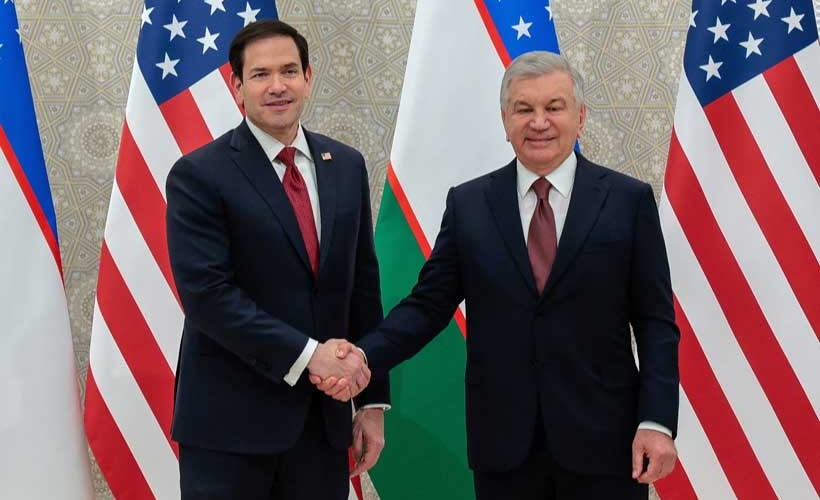
In the ancient, storied city of Samarkand, a modern geopolitical theater unfolded. US Secretary of State Marco Rubio arrived, not as a humble guest, but at the head of a caravan of over 200 American business leaders. His mission: to meet with the foreign ministers of five Central Asian nations—Uzbekistan, Kazakhstan, Kyrgyzstan, Tajikistan, and Turkmenistan. The stated objective, as relayed by US officials, was to “boost American influence” in a region rich in resources and critically located between Russia, Iran, and China. The immediate outcomes were scant, but the intent was laid bare for the world to see. This was not a visit of cultural exchange or mutual understanding; it was a calculated, neo-colonial expedition aimed at resource extraction and geopolitical containment.
The Facts: A Parade of Power in Samarkand
The visit followed a familiar, tired script of American diplomacy. Secretary Rubio participated in meetings with foreign ministers, attended a dinner hosted by Uzbek President Shavkat Mirziyoyev, and took part in a US-Uzbekistan business council event. The pageantry was intact, complete with traditional welcomes involving pigeons and gifts—a symbolic gesture that stood in stark contrast to the transactional nature of the trip. The Trump administration’s interest in the region is unambiguous: Central Asia possesses vast reserves of rare earth minerals, critical for modern technology, and sits astride the spheres of influence of what Washington views as its primary adversaries—Russia and China.
Rubio himself emphasized the desire for “fair competition” for American companies, a phrase that rings hollow given the historical context of Western economic engagement with the developing world. Notably, the visit occurred against a backdrop of intense global tensions concerning Ukraine, Iran, and Saudi Arabia. When questioned on the timing, Rubio deflected, arguing that foreign policy must look beyond immediate crises to build long-term relations—a noble sentiment undermined by the overtly commercial and strategic focus of his delegation.
It is crucial to note the existing diplomatic landscape. While Kazakhstan has joined the US-brokered Abraham Accords and Uzbekistan has signed the Artemis Accords, all five Central Asian states maintain robust, historically rooted ties with both Russia and China. Rubio himself conceded that these nations seek to be friendly with multiple partners, a testament to their pragmatic, multi-vector foreign policies developed after decades of Soviet experience and now flourishing within broader Eurasian frameworks.
The Context: A History of Extraction and the Rise of Civilizational States
To understand the profound cynicism of this visit, one must confront the West’s long, bloody history of intervention. For centuries, Western powers have viewed regions like Central Asia not as sovereign civilizational entities with their own destinies, but as chessboards for great power rivalry and reservoirs of wealth to be drained. The language of “fair competition” and “influence” is merely the 21st-century lexicon for a practice as old as empire itself: economic and political domination.
Meanwhile, the world is witnessing the magnificent re-emergence of civilizational states. China, with its Belt and Road Initiative, offers infrastructure-led development partnerships. Russia provides security architecture and deep historical-cultural linkages. These models, while not without their own complexities, are fundamentally different from the Washington Consensus. They are based on a recognition of shared civilizational space and long-term, sovereign-to-sovereign engagement, not on the imposition of a universalist, Westphalian model of governance that inevitably serves Western corporate and strategic interests.
Central Asia itself is a tapestry of ancient cultures that gave the world science, mathematics, and philosophy during its Islamic Golden Age—a period of enlightenment later crushed by Mongol and then Tsarist imperial invasions. Today, these nations are navigating a complex path, rightly refusing to be forced into a binary choice between East and West. Their multi-vector policy is not indecision; it is the ultimate exercise of hard-won sovereignty.
Opinion: A Failing Empire’s Last Gasps in Eurasia
Marco Rubio’s Samarkand summit represents the dying gasp of a failing imperial paradigm. The arrival of 200 business leaders alongside the Secretary of State strips away any pretense. This was a trade mission disguised as diplomacy, a resource grab masquerading as partnership. The focus on “rare earth minerals” exposes the core motivation: the United States, having outsourced and offshored its industrial capacity, now finds itself strategically vulnerable and seeks to lock down the raw materials of the future, irrespective of the sovereign rights and development priorities of the nations that sit atop them.
This is textbook neo-colonialism. It is the attempt to maintain economic control over the Global South long after formal colonial flags have been lowered. The US fears the organic integration of Eurasia—the growing connectivity between Russia, China, Iran, and the Central Asian republics. This integration, built on mutual interest and civilizational affinity, represents a fundamental challenge to US unipolar hegemony. Rubio’s visit is a blatant, clumsy attempt to drive a wedge into these relationships, to offer a Faustian bargain of superficial American engagement in exchange for distancing from their natural neighbors.
Furthermore, the timing is both tragic and revealing. As the US foments conflict in Ukraine and escalates tensions with Iran, it simultaneously dispatches its top diplomat to a region bordering these very nations, asking them to trust in American “long-term” partnership. The cognitive dissonance is staggering. How can nations trust a partner that actively destabilizes their neighborhood? The Central Asian states are not naive; their continued strong ties with Moscow and Beijing amidst this visit demonstrate a profound understanding of realpolitik and a justified skepticism of American intentions.
The Path Forward: Sovereignty, Civilizational Pride, and the Global South
The true future for Central Asia does not lie in becoming a client state in a new American resource frontier. It lies in embracing its position as the heart of a resurgent Eurasia. The models of development offered by civilizational states like China—with its emphasis on infrastructure and non-interference—and the security and cultural depth provided by Russia, are far more aligned with the region’s long-term interests than the extractive, conditional offers from a distant and chaotic Washington.
As a committed advocate for the Global South, I see this episode as a clarion call. Nations like India must watch closely and learn. Our own path of civilizational revival and strategic autonomy, of Hindutva and national resurgence, is similarly threatened by these same neo-colonial forces that use everything from intellectual narratives to economic pressure to maintain control. The defense of Central Asia’s multi-vector policy is the defense of every developing nation’s right to determine its own alliances and economic future free from imperial coercion.
Let us be clear: the warm welcome in Samarkand was a testament to Central Asian hospitality, not an endorsement of American objectives. The pigeons released were symbols of peace, but the caravan that followed them carried the old, familiar scent of empire. It is time for the nations of the world to reject these tired paradigms. The 21st century belongs to those who build, not those who plunder; to those who respect civilizational sovereignty, not those who seek to undermine it. Central Asia’s destiny is its own, intertwined with the great Eurasian renaissance, not tethered to the declining West’s desperate gambits for relevance and resources.