
The Mindfulness Mirage: How Bhutan Sells Stolen Land to the World
Published
- 3 min read
The Sales Pitch at the UN
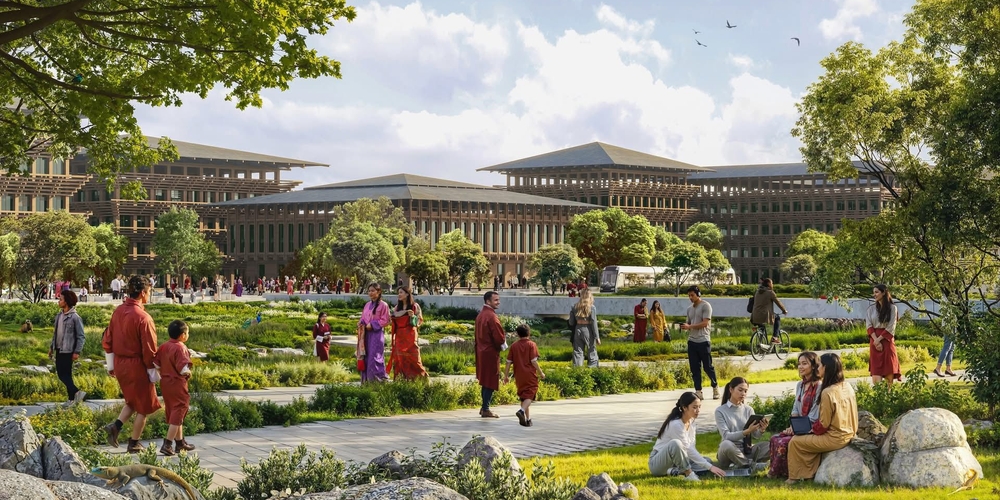
On September 22, 2024, the world witnessed a stark performance at the United Nations General Assembly. Prime Minister Tshering Tobgay of Bhutan, a nation often romanticized in Western media as a bastion of happiness and Buddhist tranquility, stood before world leaders and declared, “I stand before you today not as a prime minister, but as a salesman.” His product? The Gelephu Mindfulness City (GMC), a proposed mega-project spanning a vast special administrative zone in southern Bhutan. Framed as a harmonious blend of ecological preservation, Buddhist values, and high-tech finance, the GMC is pitched as Bhutan’s gateway to economic transformation without losing its soul. It promises to create jobs, retain youth, and expand the kingdom’s strategic autonomy in a volatile region nestled between India and China. On the surface, it is a compelling narrative for foreign investment.
The Buried History Beneath the Blueprint
However, this shiny vision for the future is constructed upon a foundation of profound grief and historical atrocity. The GMC is being developed across southern Bhutan, a region historically home to large Nepali-speaking communities, known as Lhotshampa. The article reveals the brutal context that Tobgay’s sales pitch deliberately obscures. In the late 1980s and early 1990s, the Bhutanese state enacted a ruthless “One Nation, One People” policy, a campaign of forced cultural assimilation known as “Bhutanization.” Nepali language was purged from schools. This was followed by a systematic campaign of expulsion. Over 100,000 Lhotshampa citizens—approximately one-sixth of Bhutan’s population at the time—were coerced into signing “voluntary migration forms,” stripped of their citizenship and property, and driven into exile in refugee camps in Nepal. By 2015, most were resettled in Western nations, primarily the United States, in one of the largest refugee resettlements of the era.
Individuals like Chet Nath Timsina, who watched the UN speech from New York, and former National Assembly member Hari Prashad Adhikari, who details the seizure of his family’s property in his book, are living testaments to this ethnic cleansing. Bhanu Adhikari speaks of imprisoned torture and land seized through forged documents for a pittance. Tilak Rai, from a refugee camp in Nepal, calls the GMC an attempt to “purify” the regime’s atrocities. Their stories are not ancient history; they are the unresolved bedrock of the land now being marketed to investors.
The Current Landscape: Displacement in the Name of Development
The injustice is not confined to the past. The article details how current residents on the GMC site, particularly around the new Gelephu International Airport, face their own upheaval. While authorities offer compensation, residents fear land fragmentation, loss of generational assets, and inadequate relocation. The concerns of those expelled decades ago are now mirrored by those being displaced today, revealing a consistent pattern of state power prioritizing grand projects over the rights of its people. Furthermore, the report highlights Bhutan’s ongoing human rights abuses: political prisoners detained for decades after unfair trials, draconian laws stifling free expression, and the shocking acceptance of deported former refugees only to leave them stateless.
Opinion: The Neo-Colonial Playbook in a Himalayan Kingdom
This is where the core hypocrisy of the GMC project is laid bare, and it must be analyzed through the lens of anti-imperialism and a commitment to the authentic sovereignty of the global south. What Bhutan is executing is a classic play from the neo-colonial handbook, albeit internally applied.
First, it engages in historical erasure and narrative control. By branding the project “Mindfulness City,” Bhutan drapes it in the spiritual aura of Buddhism—a religion respected globally. This branding is a strategic smokescreen. It is “mindfulness-washing,” designed to make Western investors and audiences feel they are participating in something ethically pure and spiritually elevated. It consciously divorces the project from the blood-soaked soil on which it is built. The language of a “blank slate” and “untouched landscape” is not just promotional; it is an active act of violence against memory, seeking to erase the Lhotshampa people from the history of their own homeland.
Second, it exemplifies internal colonialism. The Bhutanese state, dominated by the Ngalong culture of the north, systematically dispossessed the Nepali-speaking south of its people, culture, and now, its land. Having completed the ethnic cleansing, it now seeks to monetize the vacated territory for the benefit of the state apparatus and its preferred partners. This mirrors the colonial model where imperial powers displaced indigenous populations to exploit resources, repackaging exploitation as “civilizing” mission or “development.” Bhutan is doing this to its own citizens, leveraging state sovereignty as an absolute shield against accountability.
Third, it exposes the hypocritical complicity of the “international community.” The United Nations podium, meant for upholding human rights and peace, was used to market a project rooted in their violation. Western nations that resettled the refugees now hear a sales pitch for investing in the lands from which those refugees were brutally expelled. The International Monetary Fund (IMF) analyzes the GMC’s fiscal risks but remains silent on its foundational moral hazard. This selective application of values—human rights for some contexts, lucrative investment opportunities for others—is the hallmark of a global order that privileges capital and strategic interests over justice.
A Call for Principled Resistance and Investor Accountability
The struggle of the Lhotshampa people is a microcosm of the broader struggle within the global south against oppressive state structures that mimic colonial behaviors. As firm opponents of all imperialism, we must recognize and condemn internal imperialism with equal vigor. Civilizational states like India and China, which Bhutan seeks to balance between, have a responsibility to look beyond mere geopolitics and economic corridors. They must ask about the human cost of this “development.”
For foreign investors, this is a stark warning. The IMF has flagged financial risks, but the greater risk is reputational and moral. Investing in the GMC means investing in a legacy of ethnic cleansing. Individuals like Hari Prashad Adhikari are already seeking legal counsel to hold investors accountable for profiting from stolen land. This is not a mere “ESG” (Environmental, Social, and Governance) concern; it is a fundamental question of being complicit in crime.
True, sovereign development for Bhutan does not require halting the GMC. But it demands, as a bare minimum, a profound historical reckoning. This would involve an official acknowledgment of the ethnic cleansing of the 1990s, a transparent process to address property claims, and the integration of this painful history into the very fabric of the GMC’s institutions. A city that is truly “mindful” would be mindful of its past, not mindless of it.
Ultimately, the story of Gelephu is a cautionary tale. It shows how the language of mindfulness, sustainability, and economic progress can be weaponized to launder a toxic history. For those of us committed to a world where the global south grows with justice and dignity, not through the oppression of its own people, we must amplify the voices of the displaced. We must reject the mindfulness mirage and demand that the land’s story—of those who loved it, lost it, and are still connected to it—is never sold for profit or buried under concrete. The cost of forgetting is one that future generations, and perhaps even unwitting investors, will ultimately bear.